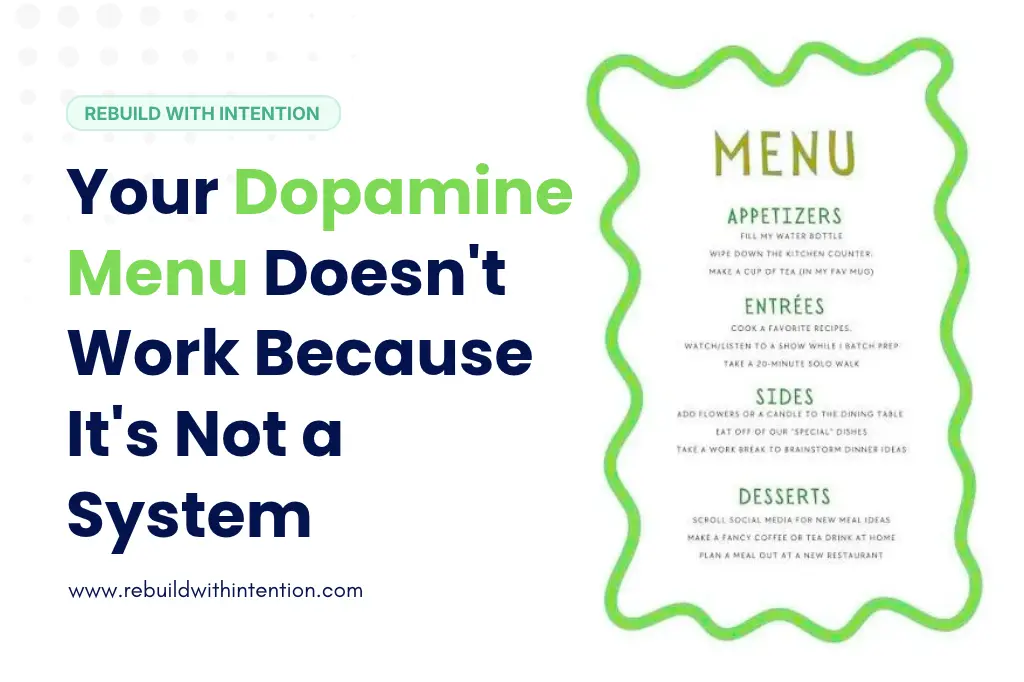
If you’ve put time into making a colorful “Dopamine Menu” but end up scrolling TikTok a few days later, you’re not alone. You’re not lazy, and your brain works just fine. The problem is with the tool itself.
The idea of a dopamine menu has become very popular among people interested in productivity and those in neurodivergent communities. They are a clever way to organize activities, but still, most people run into the same problem eventually.
A dopamine menu is a great list of ideas, but it can’t work on its own.
In this post, you’ll learn:
- Why dopamine menus fail in the real world and trigger Decision Paralysis.
- The truth behind the “dopamine detox” myth sold by the wellness industry.
- How shifting to a 24-hour closed-loop habit tracker is the secret to building actual momentum.
Why Dopamine Menu Fails
The “dopamenu” was designed to help people with ADHD start tasks more easily. It uses small, simple actions to build motivation rather than waiting for motivation or willpower. Activities are grouped as Starters (like stretching), Mains (deep work), Sides (lofi music), and Desserts (social media).

Organizing activities like this makes sense, but problems start when you try to use the menu in daily life:
The Paradox of Choice
The menu asks you to choose when you already feel overwhelmed. Picking a “Starter” when your mind is stuck is like asking someone with a broken leg to run.
Dessert Drift
The menu doesn’t set limits. Without boundaries, a quick scroll can easily turn into hours online because an under-stimulated brain will always choose the easiest dopamine.
Out of Sight, Out of Mind
People with ADHD often forget things that aren’t visible. If your menu is buried in a notes app, it essentially stops existing the moment you close the screen.
The “Dopamine Detox” Myth
As dopamine menus got popular, the wellness industry started pushing “Dopamine Detoxes” as a fix for focus issues. But you can’t actually detox from dopamine.
Dopamine is a natural, essential brain chemical responsible for motivation and movement—it’s not a toxin you need to flush out. The wellness industry uses the word “detox” simply because it sounds dramatic and sells products. If you want to fix focus issues, don’t try to eliminate dopamine; focus on building a reliable behavioral structure instead.
That’s what really helps.
Farming Dopamine through A Closed-loop Habit Tracker
If you struggle with executive dysfunction, which means your brain has trouble starting or organizing tasks even when you want to, you might feel uneasy just hearing the words habit tracker.
Truth is, many neurodivergent people don’t like traditional trackers. They use an app for a few days, miss a day, and then feel so guilty about breaking the streak that they quit altogether.
For some people, a strict tracker that makes you check boxes can trigger Pathological Demand Avoidance (PDA). This means your brain resists tasks that feel like orders, even if you wanted to do them just before.
But the problem isn’t tracking itself. Most trackers just aren’t built for how your brain works.
A dopamine menu treats dopamine as something you need before you can do hard things. But the most satisfying and lasting dopamine boost comes from finishing something, not just from stimulation.
Finishing something feels very different from just consuming something.
This is where the Rebuild With Intention Habit Tracker replaces the menu. Instead of asking, “What can I do to feel better right now?” it helps you ask, “What small task can I finish right now?”
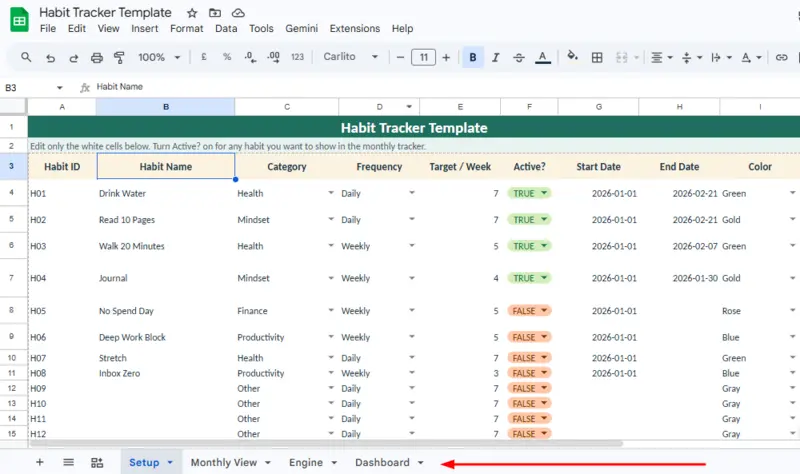
It works with a simple idea called the 24-Hour Closed Loop routine.
Here’s exactly how it works.
The “Zero Carry-Over” Rule
In a regular planner, unfinished tasks move to the next day, building up guilt. With a closed loop, the day just ends. What you finished is done, and unfinished tasks do not carry over. Tomorrow is a fresh start—like a new video game level.
Micro-Habits as Dopamine Triggers
Big tasks shut the brain down before you even start. A closed loop forces you to break tasks into tiny, single-sitting steps (e.g., “Pick a blog title” instead of “Write a blog post”). Every ticked box delivers a small, earned boost of dopamine to build momentum.
The Hard Stop
For massive projects, you set a strict time limit (e.g., “Work closes at 2:00 PM”). When the clock hits, you check the box and walk away. The loop is closed. No midnight guilt over the unfinished 80%, because your only job was completing the time block.
How to Turn Your Menu Into an Engine
You don’t need to get rid of your dopamine menu. You’ve already done the hard work of figuring out what brings you joy or focus. Now, use your menu as the database and your tracker as the engine that makes it work.
Instead of waking up and asking “what should I do from my menu today?”—the question that causes paralysis—you just pick a couple of menu items and put them into your closed-loop tracker. The choosing is done. Now you just do the tasks.
What This Looks Like in Real Life
A rigid system falls apart when life gets messy. A closed loop is meant to work with you, not against you. Here’s how it looks for a few different people. Let’s start with a Low-Capacity Day (zero energy, zero motivation).
- Cue: Open your tracker at 9:00 AM.
- Micro-tasks: Drink one glass of water. Step outside for five minutes. Reply to one essential email.
- Reward: Two guilt-free hours of gaming (Dessert). Loop closed.
Three small checkmarks, one real reward, and the day is done.
The science here is production vs. consumption
Modern neuroscience reveals that dopamine is a neuromodulator for motivation, driven by reward prediction errors. When you passively consume, you get a cheap chemical spike that leads to a deficit.
But when you produce, act, and complete, you trigger a natural, earned dopamine release that builds momentum. The closed loop works by intentionally tracking basic tasks to wrestle back control from a mind that insists it isn’t doing enough.
It proves your capability.
Maya
Remote Worker with ADHDMaya’s brain craves stimulation, so without structure, she defaults to consuming (opening twelve tabs). By tracking micro-tasks, she shifts her brain into producer mode, earning her dopamine through completion.
- Starter Stretch for 2 mins to break physical paralysis.
- Main (Micro-Production) “Export 1 revised logo.” Creating, not consuming.
- The Hard Stop 4:00 PM. Loop closes. The brain receives the “done” signal.
Derek
Warehouse Worker, ExhaustedDerek struggles with feeling like his life is slipping away. By intentionally tracking the baseline things he normally does, he takes mental ownership of his actions and stops the guilt cycle.
- Intentional Tracking Eat real food. Text 1 person back. Proving he is capable.
- The Hard Stop Loop closes the second he hits the couch. He is officially off the clock.
- Guilt-Free Consumption Watching TV is now an earned rest, not an escape.
System Diagnostics
Common questions about transitioning to a closed-loop system.
Is a dopamine menu bad for people with ADHD?
What’s the real difference between the menu and the tracker?
What happens if I miss a day? Does it ruin my progress?
How long before this starts to feel automatic?
Takeaway
A menu of distractions was never going to make your brain work. What helps is a simple system that breaks life into small, doable tasks, gives you the dopamine of checking the box, and lets you fully clock out at the end of the day.
Ready to stop overthinking and start tracking your progress? Download the free Rebuild With Intention Habit Tracker and start closing your loops today.
Discover more from Rebuild With Intention
Subscribe to get the latest posts sent to your email.