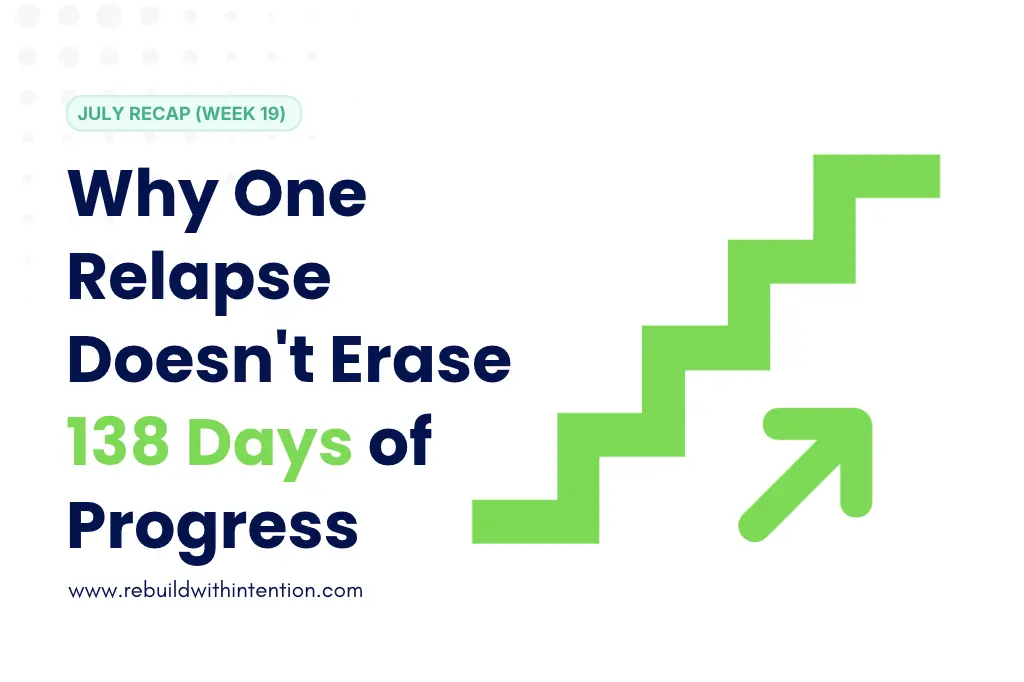
On July 31st, I looked at two numbers that didn’t make sense sitting next to each other. Day 138 of this rebuild, and Day 7 since my last relapse. For a few minutes, the smaller number tried to convince me the bigger one didn’t count anymore.
If you’ve ever tracked anything about yourself, a streak, a habit, a version of you that you were building on purpose, you know this feeling. So, the question was never really about the numbers. It’s whether one bad stretch gets to erase everything that came before it.
July is the month that answered that for me, the same month I quit a job that had been quietly taking from me for six months, and rebuilt a routine that fell apart more than once before it finally held.
Days rebuilding
Days Since Relapse
Months Unpaid Ended
A relapse doesn’t cancel months of progress, because growth was never measured by an unbroken streak. It’s measured by how fast you get back to the system you built once you fall out of it, not by whether you fell at all.
rebuild with intention
My Worth to the Market Place
On the 10th of July, I finally sent a message stepping down from a role I’d been in for over six months without salary.
I was hired as customer care, and it slowly turned into unpaid billing work for one company and payroll for another, with a salary that was never clearly defined and hadn’t been paid in six months.
A better way to say it is that I was working as a personal assistant to a consultant, for free, for half a year.
Looking back, the real problem wasn’t the job. It was a pattern I’d carried into every job: oversabi, doing more than I was asked or paid for because I couldn’t stand being seen as not enough. The market doesn’t reward that, it punishes it. The people who give the most and can’t quote their price are the ones who burn out fastest, kept around on just enough to survive rather than what they’re actually worth.
If you don’t know your value and present it as such, the marketplace treats you like a machine, and pays you only enough fuel to keep running.
Going forward, I decided a boundary rule for negotiation.
Every role you take needs clearly defined responsibilities and a price you have quoted upfront. Commit to doing exactly what you are paid to do—exceptionally well—and absolutely nothing more.
The very next day, I tested that decision.
A past client reached out about a project, and it turned into the longest negotiation of my life. This time I held my price through every objection, alas he committed to it, and we set up to start that Monday.
Closing a deal that cleanly, on my own terms, wasn’t a feeling I could remember having before.
The rest of the month tested the same lesson from the other direction. Job hunting for analytics roles meant running into listings that claimed to be remote and global but actually required a UK or US base, plus requirements of three to five years of experience I don’t have yet in this specific field, though I have it elsewhere.
I even got pulled into eight hours of community labor one day because I was jobless and people assumed my time was free to take. I came home with a thousand naira and a plate of rice, which felt like an echo of the same six months I’d just walked away from.
It’s a strange kind of disrespect, people deciding your time doesn’t matter simply because you don’t currently have a physical job.
That frustration eventually turned into a bigger question. I started asking myself how I’d feel if I didn’t need other people’s decisions at all, since right now I need them for almost everything:
- landing a job
- landing a gig
- getting help
I have to convince someone else of my value before they decide whether I’m worth investing in, and if it doesn’t work out, I’m often left guessing which part of me to fix.
But I worked six months for free and didn’t starve a single day. If I can survive that, I can dedicate six months to building something of my own instead, something that might actually pay my bills rather than someone else’s.
The Urges I Kept Losing To
Around the same time, I tried to force a different kind of fresh start. I cleared my browsing history and data, wanting a clean digital slate, and in the process locked myself out of an account I still needed for work, having forgotten I didn’t have the password saved anywhere else.
There is a hidden danger in trying to force a perfectly clean digital or mental slate. When you over-correct out of fear or a lack of self-trust, it is easy to accidentally uproot the very systems keeping you grounded.
After regretting my mistakes for about half an hour, I eventually had to find a workaround by getting a new account to continue my work.
Over the following two weeks, I started falling back into the same old habits I thought I had already beaten. Some days, I spent all my energy indoors, fighting the urge until the day was over—which was exhausting. Other days, I just gave in. I didn’t even bother tracking the failure, and that lack of caring scared me more than the relapse itself.
The urges started slowly and then all at once.
I went from a stretch of a hundred-plus days where I’d kept my distance from any visual consumption, to spending four or five hours a day on movies, YouTube, and TikTok, and my mind started quietly arguing that the old habit was normal. Which it wasn’t, at least not for where I was going.
I know it was a typical escapism. And there’s a name for that specific one, avoidance coping.
The act of reaching for a distraction—like endless scrolling or old habits—specifically so you do not have to sit with the discomfort underneath it.
I noticed I’d stopped focusing on what I had and started fixating on what I didn’t, which is around the same time I forgot, for a stretch of days, that I was even in the middle of rebuilding anything at all, even though this rebuild was the one thing that had carried me through worse than this before.
The very things I used to avoid, movies, social media, PMO, had become the exact tools I reached for to escape the discomfort of the moment.
Looking back at how it all came apart, the order makes sense.
1. The Catalyst
The unpaid salary pushed me to a breaking point, forcing me to quit and disrupting my baseline stability.
2. Physical Friction
A bout of sickness and stomach inflammation meant I physically couldn’t execute the movement my morning routine depends on.
3. Mental Static
Residual blame and frustration from working half a year without proper pay clouded my focus and drained my willpower.
Getting Back Up
The turning point came on 21st of July. My alarm was set for 4am. I woke up, went to the restroom, and walked straight back to bed, lying there wide awake until 4:36, essentially begging myself for more sleep. I thought: “why is it so hard to follow something this simple?”
It reminded me of how the Israelites kept drifting back into old patterns the moment things got easy, and how it usually took years of difficulty to bring them back to seeking God again.
If you’re already seeking that every day, you don’t need a crisis to force you back to it.
I got up immediately, redrafted my routine on the spot, and followed it. I didn’t hit my full set of pushups that day, but I got there the next.
By the end of the month, I was sitting with the two numbers I opened with: Day 138 of this overall rebuild, and Day 7 since my most recent relapse.
The Abstinence Violation Effect
Addiction researchers define this as the cognitive trap where an individual believes that one slip proves the whole effort has failed.
The Danger is, this mindset makes a full relapse highly likely, because the brain assumes there is nothing left to protect once the streak feels ruined.I didn’t have a word for it then, what I had instead was an old memory of learning to walk.
Before we learn to walk, we crawl, then take a few steps, then fall. Once we’ve learned to walk, we don’t stop just because it got easier, and we don’t crawl back to the beginning every time we trip as adults. We get up, notice what caused the fall, and keep moving.
I’m not the same person I was before I started this in March, and that’s true regardless of what the streak says. I’ve stopped counting streaks altogether, because a relapse doesn’t cancel the growth underneath it.
The honest realization was that my systems never failed me. I simply stopped using them.
Each one depends on the others the way stones depend on each other to hold up a house.
If I can accept that the system is already good enough, that it will never feel effortless, and that I don’t get to outgrow it, it will eventually just become part of who I am.
I also understood something about joy and happiness this month that I want to hold onto.
Joy
Comes from within. It is a choice rooted in contentment with what you already have.
Happiness
Comes from without. It is highly tied to comparison and external circumstance.
That’s why I could still feel joy through months without a salary, even though I wasn’t happy about the situation itself.
The trouble started the moment I began paying attention to what I lacked and what other people had, which is what pulled my focus toward happiness and away from joy in the first place, and it’s a large part of why the rest of the month unraveled the way it did.
Read my article of Joy vs Happiness here.
Wrapping Up
There’s a principle I keep coming back to, a void principle.
A void cannot actually exist. Darkness is the absence of light, not its opposite. Evil is the absence of good, and hate is just the absence of love. There is no neutral middle ground.
None of them are separate forces fighting each other, they’re just what’s left when the other one is missing, and believing you can sit in some neutral middle ground is its own quiet form of ignorance, one that always comes with a cost.
If I’m not living with intention, something else is living my life for me, consciously or not, but a life gets lived one way or the other.
So that’s July. I don’t stop living because I fell somewhere in the middle of it. I keep going, and I keep the one rule I never want to break again: never go a day without journaling.
Discover more from Rebuild With Intention
Subscribe to get the latest posts sent to your email.