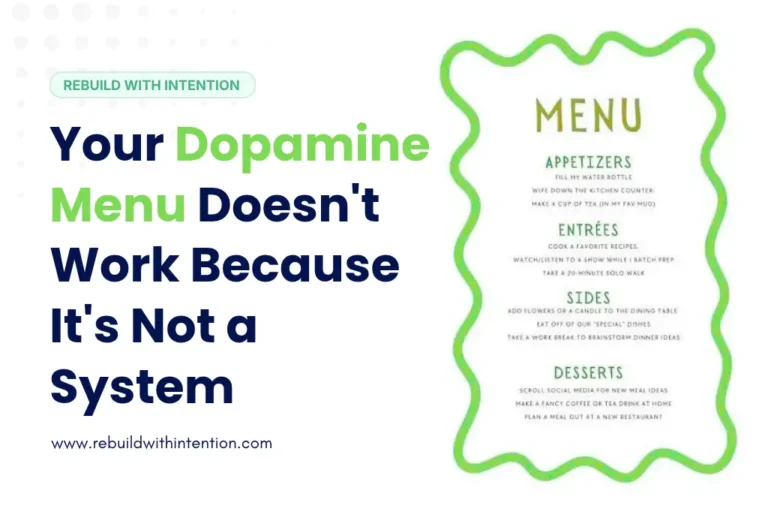
In this age where instant dopamine is everywhere, easily accessible even to children as young as two or three, I had to ask myself: Where do I get my own dopamine from?
Quick Overview
Modern society has traded the deep satisfaction of the “biological hunt” for the cheap, unearned dopamine of social media algorithms.
Following a forced digital detox, this essay explores the psychological traps of the digital age and offers a framework to step off the hedonic treadmill and reclaim intentional living by actively earning your joy.
Dopamine is the chemical that makes us feel good.
Today, the go-to place for an excess amount of dopamine is social media. This is why many teenagers today prefer to skip meals just to save their food money for internet data.
They save up to buy the latest phones while depending on their parents to buy their clothes and basic necessities.
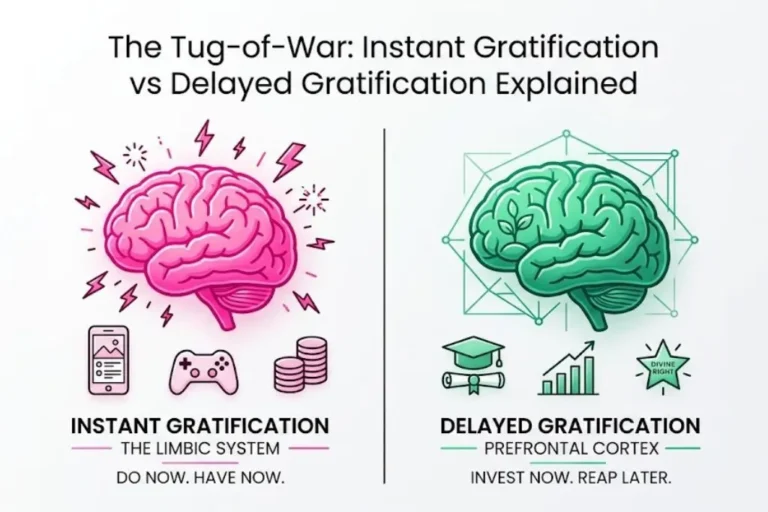
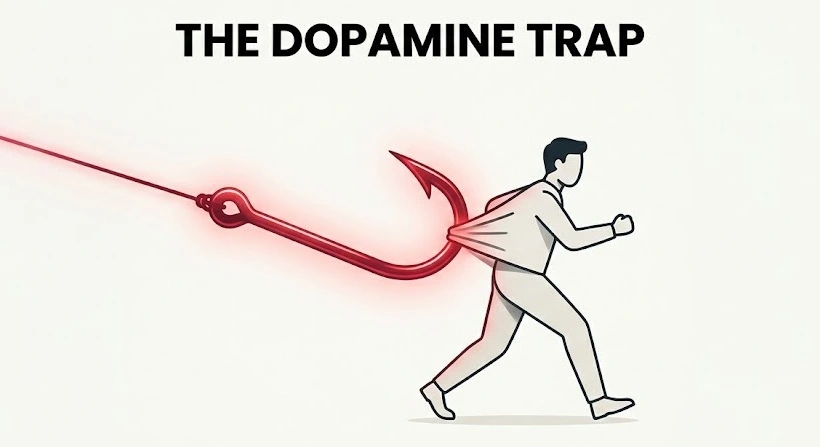
Dopamine is highly addictive, and the way we source it has completely changed.
How Did We Get Here?
The Generational Shift
The 1990s: Earned Dopamine
- Joy derived from working, farming, and rigorous studying.
- Building meaningful connections and strong real-world networks.
- Spending intentional, uninterrupted quality time with families.
Today: Cheap Dopamine
- Exhausting heavy data bundles on K-dramas and video games.
- Mindless scrolling and platform-jumping on TikTok and YouTube.
- Chasing likes and letting algorithms dictate personal worth.
In the 1990s, people got their dopamine from working, farming, studying, and building meaningful connections. They found joy in strong networks and spending quality time with their families.
Today, with the excess availability of smart devices and social media, we now get our dopamine from mindless scrolling, posting, and chasing likes.
I was sitting in the office recently, and I grew curious: How did I get to this place?
I used to be super addicted to my phone. Unless I was actively working, my phone was always in my hand. It usually took me less than a minute to respond to a message.
In addition to working online, I would buy heavy data bundles and exhaust them on K-dramas, video games, and mindless scrolling on TikTok, Facebook, and YouTube.
I literally jumped from one platform to another.
However, some months ago, life threw me a curveball. I was robbed of my phone. To make matters worse, my company hasn’t paid salaries for 5 months, leaving me too broke to buy a replacement.
This forced me into a corner, but it also pushed me to actively live every day with intention.
I managed to get a small device with no internet access. When I was bored at work, I would play a brick game on it—and I realized it was still about chasing that dopamine hit.
I still have access to the internet on my laptop, and I spend a few hours on YouTube watching gameplay and tutorials, but I no longer have access to mobile games, movies, or the constant stream of content that used to give me a quick dopamine fix.
This experience made me curious about where other people get their joy from. I know Gen Z gets their dopamine from social media, but what about my own generation?
The Danger of Cheap Dopamine
The world is becoming a place where you don’t need real achievements to feel good.
It is important to note that parents have a massive role to play in the betterment of society today.
The best gift a parent can give to their child is to become a mentor to them. But what if that parent is also an addict? Addicted to their phone, to social media, adult content, or even to work?
We need to feel the need to do the actual work for the rewards we get.
I’m not saying social media is inherently bad. But if I tie my identity to an algorithm, I am setting myself up for failure.
The Psychology of the Feed
— Simon Sinek, Leadership Expert
The False Equivalence Fallacy
This occurs when we mistakenly equate a digital “like” or view count with our actual human worth. It forces us to tie our identity to an algorithm, leading to devastating drops in self-esteem when our posts don’t get the reach we expect.
The Hedonic Treadmill
The human brain quickly adapts to new rewards. The moment we hit a new milestone online (like 100 likes), the dopamine spike fades almost instantly. This forces us to keep running on a digital treadmill, posting more and scrolling longer just to feel “normal.”
If I upload content that the algorithm favors, gets massive reach, and earns lots of likes, I feel great. But if I upload another piece of content and it gets fewer likes, I feel like I am doing something bad or not doing enough.
That is basically giving an algorithm the power to dictate my life.
But when I am busy focusing on myself and building my real-world skills, I get a true sense of success. I get recognition not from an app, but from my family, friends, and colleagues.
Where Do You Get Your Dopamine From?
We need to start earning our rewards again and teach the upcoming generation to do the same.
Biologically, dopamine was meant to be our reward for the “hunt”—the surge of satisfaction we feel when we complete a hard project or achieve a physical goal.
It was never meant to be free.
✅ A farmer gets his dopamine from farming and harvesting. Because he knows he did a great job planting, he knows his harvest will be plentiful.
✅ An artisan gets their dopamine from their output. They create something with their hands and find joy in knowing it is good.
✅ Doctors, lawyers, and other professionals get their dopamine from saving lives and helping people. It isn’t just the money; it’s the tangible impact of their hands and minds.
✅ Creators and entertainers get dopamine from making good videos, writing great articles, landing a good joke, or engineering a complex dance step.
The Psychology of Earned Dopamine
Why the groups mentioned above find lasting, algorithm-proof fulfillment.
Deliberate Effort
Engaging in the “biological hunt” through physical labor, study, or creative problem-solving.
Tangible Output
Producing a real-world result: a harvested crop, a saved life, or a masterful piece of art.
Enduring Reward
A deep, sustainable dopamine release driven by genuine purpose and impact.
These people are true creators.
They can exist without social media because their fulfillment comes from their field, not the feed. They publish their content online, but their identity isn’t tied to their likes.
Compare this to the mindless scroller who has killed their natural drive for earned dopamine. They ignore their time, their environment, and their studies.
They desire the shiny objects they see online and look for shortcuts—like fraud or meaningless posts—to attain them.
Rebuilding with Intention
It is one thing to be successful; it is another to learn to manage that success, because it can be overwhelming. It goes beyond just enjoying life.
It requires actively asking yourself: If I were to die today, would I have no regrets?
Not everyone has the money or potential to access a great mentor.
For those of us living in the trenches, climbing our way up from the bottom, we must live our lives with great intention and great conviction.
To start rebuilding your life with intention, the first step is to identify where you are getting your dopamine from.
If you are earning it through hard work and creation, I salute you. But if you are getting your dopamine cheaply, you need to rewire your brain.
We simply stop using our brains and let our environment, algorithms, and AI dictate our lives.
You are not weak. No human being is born weak, dumb, or without purpose.
The 24-Hour Challenge
I’m curious, can you leave your phone completely for 24 hours without falling into depression? What will you do during these 24 hours? Think about it, give it a try, and I will be glad to hear from you in the comment box.
Discover more from Rebuild With Intention
Subscribe to get the latest posts sent to your email.