What is the difference between systems and goals?
A goal is a future outcome you want to reach. A system is the repeatable process, routine, environment, and feedback loop that moves you toward that outcome. Goals help you choose a direction, but systems help you make progress when motivation is low.
Setting a massive goal feels incredible. Until the next morning.
You write your grand plans down at night, feeling unstoppable. You imagine the finished, polished version of your life, and for a few minutes, you feel incredibly powerful.
But when you wake up the next morning, your energy is nowhere near what you expected. That same old habit you swore you broke is waiting for you in the same old place. You promised yourself you would be different this time, but here you are again.
Why does this happen to all of us?
Because society has taught us to obsess over the finish line while completely ignoring the engine that gets us there. We are taught how to set goals, but never how to build systems.
As the science of habit formation proves, you don’t need more willpower or motivation. You need a repeatable process that creates undeniable proof of progress.
Quick Summary: Systems Over Goals
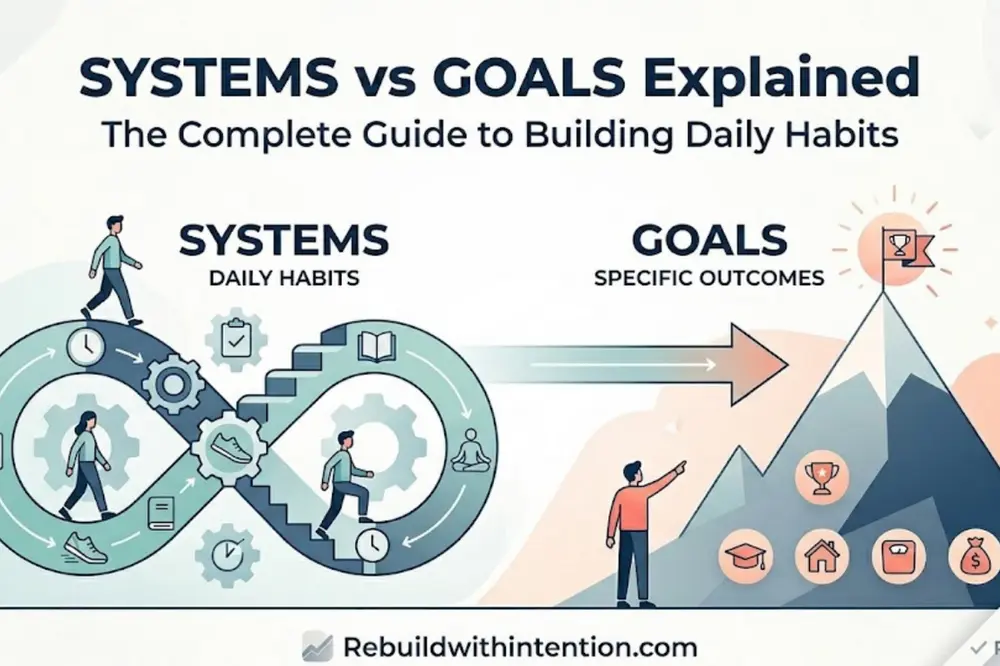
Systems vs Goals Explained
A goal is what you want to achieve in life, like something you dream of reaching. A system is the regular and simple steps you follow every day to help make that dream come true.
To reach your destination without quitting halfway, you have to understand the difference between systems and goals.
Let us use a road trip as an illustration.
Your Goal
The specific, future outcome you want to achieve on the map (like writing a book, hitting a revenue target, or losing 20 pounds). It tells you exactly where you want to end up.
Your System
The daily operating machinery—the fuel, the steering wheel, and your habits. It is the unglamorous, repeatable process that actually gets you there.
Most people believe that consistency is a result of willpower. They wake up on January 1st with a “big goal” and a fresh burst of motivation, only to find themselves back at square one by February.
This happens because they are focusing on the outcome (the goal) rather than the machinery (the system).
As James Clear famously noted in Atomic Habits, “You do not rise to the level of your goals; you fall to the level of your systems.”
To make a permanent identity shift, you must stop obsessing over the finish line and start optimizing your daily feedback loops.
ModelThinkers explains that systems are more about the small choices we make every day than about far-off goals we want to reach.
Bottom line is that setting goals is not wrong. I’m not saying we should set goals, but relying solely on them can make it fall apart. It’s far more effective to concentrate on daily routines and the choices we make.
Goals
Systems
Why Goals Feel Good but Often Break Down
Goals feel incredible because they allow you to borrow emotion from the future. You get to vividly picture the result before you have paid the actual cost in sweat and time.
That can be undeniably useful for a moment—it gives you a spark and a reason to start. But if you stay too long living in that imaginary future, you can easily become addicted to planning your life instead of actually practicing it.
I know that specific pattern intimately well. It is so easy to build a beautiful, flawless version of yourself inside the pages of a notebook.
It is significantly harder to wake up the next morning and do the small, tedious thing that no one will notice. The small thing has no applause.
The small thing does not announce a grand comeback to the world. It just quietly asks for repetition.
A system lets you win smaller, earlier, and far more honestly because you get to feel the victory of success every single night.
You do not have to wait until you have completely rebuilt your entire life to collect proof of your progress. You collect undeniable proof the moment you repeat the process today.
The Open Loop
Relying solely on a massive goal creates a state of perpetual “not-yet.” You borrow emotion from a future that hasn’t arrived, creating a fragile mental loop that breaks the moment you face a bad day.
- Burnout through delayed fulfillment.
- Toxic “all-or-nothing” behavior.
The Closed Loop
A system acts like a high-performance engine. You perform the work, fulfill the requirement, and close the loop today. You collect undeniable proof of progress every night, regardless of the summit.
- Immediate victory every 24 hours.
- Unsuspension of daily satisfaction.
Takeaway: Do not ask yourself, “Did I become the new version of myself today?” Instead, ask, “Did I practice the system that makes that version more likely?”
Goals Are Not the Enemy
Some people hear the phrase “create systems, not goals” and mistakenly think they should completely abandon goal-setting forever. I do not think that is a practical way to live.
Having goals is really important.
A goal gives you clear direction and shows you what you should focus on. Without a goal, your daily activities can turn into meaningless tasks.
You might find yourself doing the same things over and over again, feeling busy and organized, but your life doesn’t actually change.
The core problem is the lack of a system. The problem is worshiping the goal while completely neglecting the machinery underneath required to get you there.
Think of it exactly like marketing data analysis.
A business can set a massive goal to increase conversions, grow organic traffic, or double its revenue. But that goal is functionally useless if their tracking is broken, their analytics dashboard is unclear, and nobody actually sits down to review the data.
The “Marketing Data” Checkup
A personal system is simply a data dashboard for your life. Is your tracking broken?
Scenario: Worshiping the Goal
The business wants to “Double Revenue” (the distant destination) but has no conversion tracking installed. Every effort is a blind guess, creating immense anxiety and zero strategic progress.
Scenario: Running the Machinery
Instead of watching the massive revenue goal, the team shifts 100% focus to their daily “Marketing Machinery”: Check tracking pixels, verify landing page speed, and review ad spend every 24 hours.
The Strategic Difference
The goal tells the team *what* they want. The system (the dashboard) provides immediate feedback on *how* to adjust the process to guarantee that result occurs.
The goal tells the executive team what they want to happen. The system tells the workers what to check, what to fix, and what specific decision to make next.
For more on tracking, read our guide on How to Track Your Daily Habits
The Rebuild Operating System: A Practical Framework
Here’s a simple approach you can follow when a goal seems too big and your daily routine feels tiring:
Be Honest About What Needs Change
To make real changes, you need to be honest about where you are right now. Look closely at your life. Are there negative things keeping you in a loop? Where are you losing time, money, energy, or attention?
Pick a Small Action You Can Repeat
Your plan should be so simple that it’s manageable even on tough days when your energy is gone. If your routine only works when you’re feeling highly motivated, it’s not truly a system yet—it’s more like a performance.
Connect Your Action to a Specific Trigger
Don’t just keep your plan in your mind. Anchor it to a specific time or event in your day. For example, do it right after breakfast, before you brush your teeth, or every Friday at 6 p.m. sharp.
Track Progress, Not Perfection
Keeping track is not a tool to make you feel bad if you miss a day. It is data to see how you are doing. Use a simple checklist, a short journal note, or a habit tracker to prove to yourself that the system is actually working.
Review and Repair the System Weekly
If the system breaks down—and it will—do not attack your own identity. Stop calling yourself lazy. Ask mechanical questions: Was the task too big? Was the cue too weak? Adjust the machinery instead of giving up.
“Discipline is not an inherent personality trait. It is a system you actively have to build, review, and practice.”
Examples of Systems vs Goals
The easiest way to understand this is to stop speaking in outcomes and start speaking in repeatable actions
| The Goal (Outcome) | The System (Repeatable Action) |
|---|---|
| Write a bestselling book. | Write 500 words every morning before checking email or social media. |
| Get entirely out of debt. | Review spending every Friday, prioritize one bill, and update a debt tracker. |
| Get in the best shape of my life. | Take a 20-minute walk after dinner and go to bed at a consistent hour daily. |
| Double business revenue. | Spend the first 45 minutes of every workday pitching three new potential clients. |
| Reduce stress and anxiety. | Meditate for 10 minutes immediately after waking up, before touching my phone. |
How to Create Systems, Not Goals
The absolute easiest way to internalize this mindset is to stop speaking in terms of outcomes and start speaking exclusively in terms of repeatable actions.
First, write down your main goal at the top of a page. Then think about what actions you need to take every day to reach that goal. Ask yourself:
- What would a person who is already achieving this goal do each week?
- What things would they take away from their life?
- What would they keep track of or measure?
- What would they look over and think about on Sunday afternoons?
Then, deliberately reduce that answer until it looks almost absurdly too small. This is incredibly important.
A system that looks highly impressive on a piece of paper but totally collapses when you have a headache in real life is not strong. It is just decoration.
The better, more resilient system is usually deeply boring. It simply repeats. It has an obvious cue. It has a designated place. It has a clear way to notice when it is working. And crucially, it has a built-in repair plan for the inevitable days you miss.
Free PDF: “Create Systems Not Goals”
If you are looking for a practical way to start, I put together a free “Create Systems Not Goals” PDF worksheet. You can download it right here to map out your own daily framework.
The One-Page System Framework
Use this interactive blueprint to audit your current environment and turn one goal into a repeatable, low-friction system.
Download Framework (PDF)If you prefer to write it out yourself, here is the one-page framework to copy into your notebook:
If you prefer to write it out yourself, here is the one-page framework:
The Quiet Part: Systems Expose the Truth
When you only have a massive goal, you can constantly negotiate with yourself. You can tell yourself you are still serious about it.
You can confidently say you are just waiting for the “right time” to begin. You can keep the dream perfectly clean because it has not yet had to touch the messy dirt of an actual Tuesday afternoon.
A functioning system aggressively removes your favorite hiding places.
With a goal, you can constantly negotiate with yourself. You can claim you’re waiting for the “right time.” But a system exposes the truth. You know immediately if you took action today, or if you’re just clinging to the same habits that keep you stuck. It’s uncomfortable, but you cannot mend what you refuse to acknowledge.
Once you establish a system, everything becomes clear. You automatically know if you really take action today.
You know if the first step you chose is too overwhelming.
You will be able to tell whether your surroundings undermine your intentions or whether you are just claiming to want change while simultaneously clinging to the same habits that keep you back.
Confronting that truth can be quite uncomfortable, but I assure you, it’s ultimately a kindness. You can’t mend what you refuse to acknowledge.
There are days when the biggest victory is not adding to the chaos. You close one open loop. You write a clear, honest sentence. You pay off one overdue bill.
You take a peaceful walk. You remove one negative trigger from your workspace. You go to bed and wake up the next day with a little less chaos than the day before..
Common Mistakes When Building Systems
Making the system entirely too big
If your daily routine demands your absolute best mood, your highest energy, and a perfectly quiet environment, it will absolutely not survive normal, messy life.
Tracking way too much data
You do not need a complex, color-coded dashboard for every breath you take. Only track the vital few actions that actually move the needle on your outcome.
Confusing motion with progress
Endlessly researching new productivity tools and rewriting plans can feel productive. It isn’t. The system needs actual reps, not endless, perfect preparation.
Never reviewing the machinery
A system is not meant to be a prison sentence. It should be tweaked and adjusted the moment the evidence tells you something in the chain is not working.
Using systems to avoid courage
Sometimes, the very next step is not building another morning routine. Sometimes the actual required step is the highly uncomfortable, honest conversation, sending the application, making the scary payment, delivering the apology, or finally making the hard decision.
So, Which One Should You Focus On?
Use goals to choose your ultimate direction. Use systems to create your daily progress. That is the only balanced, sustainable answer.
Your goal can absolutely be the north star, but your system is the grueling, daily route you walk. Your goal is to name the mountain you want to conquer.
Still, your system is the rigorous climbing schedule, the meticulously packed bag, the months of physical training, the planned rest days, and the gritty decision to keep putting one foot in front of the other when the summit is completely covered by thick fog.
“A goal shows you the life you dream of, while a system gives you a steady way to practice and improve your life every day.”
Do not throw away your goals. Just stop actively asking them to do what only daily structure can do.
If your life feels chaotic and scattered right now, do not start by promising yourself a dramatic, complete transformation by Monday.
Start by building one single, boring system that gives you tangible proof of progress. Proof is incredibly quiet, but it compounds heavily over time.
Proof is what actually helps you learn to trust yourself again.
Frequently Asked Questions About Systems vs Goals
What is the core difference between systems and goals?
Why do goals so often lead to failure and burnout?
How do I build a system instead of a goal?
Are goals unnecessary if I have a good system?
How often should I review and repair my system?
Discover more from Rebuild With Intention
Subscribe to get the latest posts sent to your email.