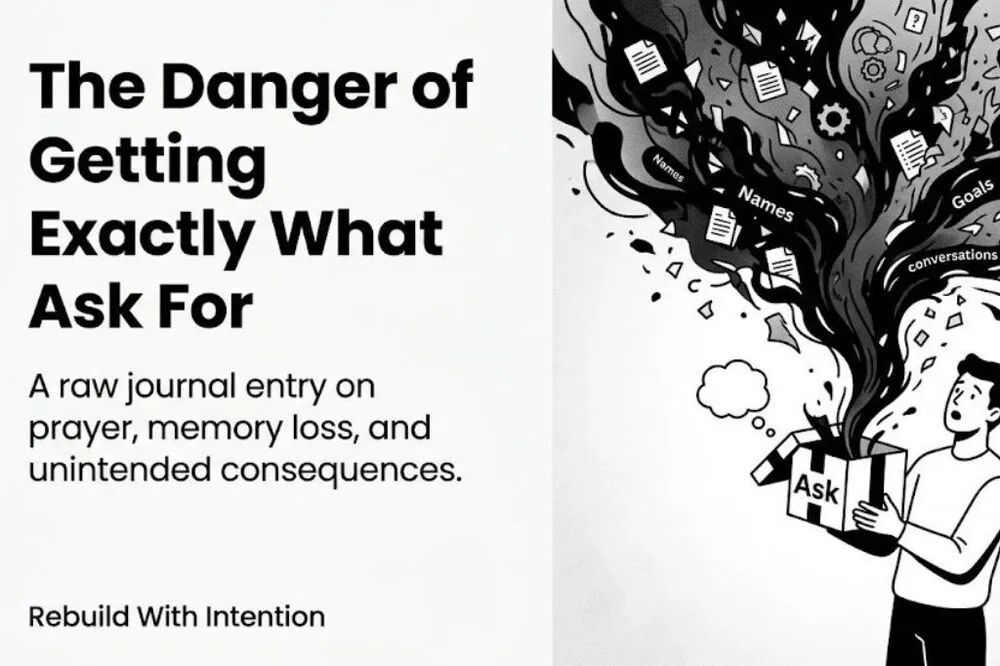
While praying today, asking God for knowledge and a retentive memory, I was hit with a sudden, jarring realization.
I was reminded that I actually asked for my memory to be taken away in the first place. This happened a long time ago, and I hadn’t thought about it until this morning.
I was young then, but the memory of that specific prayer came back as vividly as if it were yesterday.
It forced me to confront a terrifying truth about the human mind: our brains are incredibly obedient.
If you demand that your mind shut down a specific function to protect you from pain, it will comply.
But years later, when you actually need that function to build your empire, you have to fight tooth and nail to get it back.
To understand why anyone would pray to lose their memory, you have to understand the burden of unearned brilliance.
In my teenage years, I was unbelievably smart. I possessed a strong, almost photographic memory. I didn’t read for exams.
When the state introduced mandatory study time for students, I used my reading time to play games. I never had a private study time; those hours were reserved for movies.
I carried my arrogance into higher education. Even during this time, I would watch movies the morning of an exam, stroll into the exam hall, and still perform well.
I graduated with an Upper Credit, but not achieving a distinction wasn’t due to a lack of ability; it was a conscious choice underpinned by a flawed mindset I had completely embraced.
The Great Deception of the “Backbencher”
In high school, I internalized a belief after listening to adults talk. They claimed that brilliant people—the ones with distinctions—are the ones who end up working 9-5 jobs.
They are the gears in the machine, driving organizational results while remaining poor, depending on bank loans to buy a car, and constantly begging for promotions.
Then they talked about the “backbenchers”—the less serious students, the ones who struggled to pass.
According to these adults, these were the future CEOs who would eventually hire the smart graduates, using the brilliant minds of others to make themselves rich.
To my younger self, this made perfect sense. It gave me a convenient excuse to coast. Around 2013, I made a concrete decision: I would never work a 9-5 job.
I would never use my certificate to beg for employment. I held onto this belief like a religion and started looking for ways to make money online.
What they didn’t explain to me is that the “struggling backbencher” who becomes successful doesn’t fail because they are poor students. They succeed because their early challenges teach them to plan, grow stronger, and learn to deal with failure.
Since I didn’t face academic struggles, I never learned those important skills. Just being smart without discipline will only lead to mediocrity.
Raw intelligence without discipline is just a ticking clock to mediocrity.
Trading Memory for Peace
When I gained admission in 2014, my character was deeply flawed. I was constantly angry. The smallest inconvenience would set me off.
I kept malice with an intensity that terrified people. If you didn’t respond to my greeting, or if you wasted even three minutes of my time, that was enough for me to cross you out of my life forever.
My retentive memory entirely fueled my anger. I could remember, word for word, exactly what a person said to annoy me. And I would replay it.
The more I remembered, the angrier I became. It was as if I was born with a baseline of rage.
Knowing I was destroying myself, I prayed to God to remove this anger. That led me to a massive psychological breakthrough:
You only stay angry if you remember. Rumination is just anger looking for a reason to stay alive.
Suppose you hold onto what someone did and take it personally; the anger ferments. So, I changed my prayer. I explicitly asked God to reduce my retentive memory so I could forget things faster.
Alongside that prayer, I built a physical system to override my emotional baseline. I forced myself to stop taking everything so seriously.
I mandated a physical action: I put on a deliberate smile whenever I talked to people.
I practiced this daily, forcing the muscle memory, until it became so automatic that I was given the nickname “Elerineye”—the smiling face.
I hacked my own psychology by changing my physical state.
Today, the consequences of that shift are clear. My brain now operates in a permanent state of triage. Because I have put myself through the kind of stress and rebuilding that triggers survival mode, small talk doesn’t register anymore.
Unless a piece of information is tied directly to my immediate survival, my goals, or an action I need to take right now, it evaporates.
The Blueprint for Rebuilding
I feel stuck, and to move forward, I need to improve my memory. I want to strengthen my ability to remember long-term goals, so they don’t get lost in the busy day-to-day life.
I see my boss, and I am amazed. He handles a lot of important work, but he can remember exact money figures, small details about plans, and what you told him a month ago.
That level of recall isn’t just a parlor trick; it is the ultimate tool of leadership. Remembering small details about your subordinates proves that you actually care about them. You cannot fake that level of attention.
A memory like that is both a divine gift and a rigorously trained muscle. So, I am aggressively pursuing both.
I have been destroyed in a thousand ways, mostly by my own hand. But because of that, I know a thousand ways to rebuild myself.
What I Unlearn vs What I Am Learning (Toxins vs Blueprint)
The Myth of the Lazy Genius
Natural brilliance is a liability if it prevents you from learning how to struggle. The real world will crush you when talent isn’t enough.
Intentional Friction
Daily physical and mental disciplines—completed every single day without fail—are required to keep the ego in check and build mental muscle.
Using Memory as a Weapon
Holding onto past wrongs doesn’t protect you; it poisons you. Rumination is just anger looking for a reason to stay alive.
State Control
You can rewire your internal emotions by forcing yourself to perform external physical actions. Smiling when you are angry forces the brain to break its automatic negative loops.
The Brain as a Storage Drive
Your brain is a processor, not a hard drive. Trying to memorize everything causes mental fatigue. You must externalize your memory into journals, lists, and systems.
Systematized Empathy
Remembering a person’s name or a small detail from a past conversation is a leadership skill that must be practiced deliberately.
Final Thoughts
Rebuilding isn’t just about acquiring new skills; it’s about taking inventory of the wreckage and deciding what is worth salvaging.
I spent my youth trying to handicap my own mind because I lacked the discipline to control my emotions. Now, I am paying the tax for that shortcut.
But awareness is the first step to optimization. You can’t fix a system until you understand exactly how you broke it in the first place.
Until you make the unconscious conscious, it will direct your life, and you will call it fate.
Discover more from Rebuild With Intention
Subscribe to get the latest posts sent to your email.