Drift is the dangerous illusion of moving forward while slowly steering away from your true purpose. True growth requires a closed-loop system of daily, completed actions—like writing and skill-building—that align perfectly with your ultimate mission of financial freedom.
We have all been there, that frustrating, paralyzing space where you are working your ass off, yet the spark is slowly dying, and you find yourself endlessly scrolling or tweaking trivial things just to feel a false sense of control.
I felt the overwhelming weight of the trenches pulling me back down into mediocrity. But giving in was simply not an option.
I had to rip the band-aid off, sit down in an empty room with myself, and confront the brutal, unfiltered truth about my daily systems.
This journal documents exactly how I identified where I was drifting, the painful realizations I had to accept, and the rigid steps I took to reclaim my discipline this week.
What this week actually taught me
Drift doesn’t always look like laziness. Sometimes it looks like being busy with secondary things (blog design, tools, AI experiments) while quietly abandoning the work that actually moves the needle.
Writing is still my strongest closed-loop activity. It gives me a finished win every day in a way that skill-building alone doesn’t yet. When a simple cue breaks, the whole system bleeds. So the new order is simple: mornings for journaling + MDA course, evenings for undistracted writing. Everything else is secondary.
The Truth About Growth vs. Drift
This is Week 7 of my rebuild journey. And to be honest, it was not a perfect week. It was not a highlight reel. It was an honest week.
It was a week where I had to notice myself drifting, look myself in the mirror, tell myself the ugly truth, and forcefully return to the things that actually keep me aligned.
There is a real difference between growth and drift. You can be going at absolute full speed, executing tasks flawlessly, but heading in the completely wrong direction.
What is Drift?
By drift, I mean slowly moving away from your real direction while still looking productive on the surface. Drift does not always look like laziness. Sometimes it looks like doing many “good” things that are not the main thing.
You can be busy. You can be active. You can even be doing good things. But if those things are not violently aligned with the reason you started your journey, then it is still drifting.
I was not satisfied with my output on Day 45 because I did not write my journal. I was not happy with my state of mind. The spark I felt when I started this recovery journey seems to be rapidly diminishing.
BTW, here’s what my daily routine look like on Google Spreadsheet:
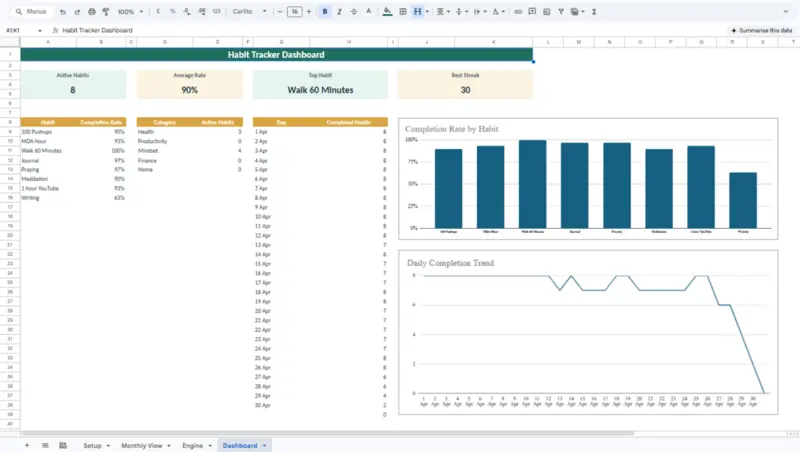
So, I had a little meeting with myself and I.
I asked myself a hard question: I have not changed my routine from Day 1 till today, so what the hell went wrong?
Then I discovered something terrifying. I have not been writing as much as I used to.
I have been outsourcing my brain, using AI too much. I have been letting my YouTube screen time creep up to more than an hour a day.
I have been focusing heavily on my blog design, tweaking CSS, and obsessing over aesthetics rather than my results, my skillset, or my core purpose.
I had forgotten that this blog is strictly for documentation, and I had slowly, subconsciously become money-driven again, hoping for quick traffic.
That was incredibly hard to admit because everything looked so reasonable and productive from the outside.
- Improving my blog is not bad.
- Building a portfolio page is not bad.
- Building tools like RebuildOS and a habit tracker is not bad.
- Learning how to present my work better is not a bad thing.
But when those secondary things begin to replace the fundamental work I started this journey for, then the system is fundamentally broken.
On Day 1, I identified my “why” and wrote a personal commitment letter that I promised to read every single day.
I had to pull it out and read it again:
Personal Commitment
I am committed to building financial stability so I can eliminate debt and take full ownership of my life. I refuse to live under financial pressure or spend my life working only to repay what I owe. I take responsibility for my past decisions and use them as fuel to create a better future.
I am focused on developing the skills, discipline, and income streams necessary to provide for myself and, in the future, for my family. I will break the cycle of limitation. My children will not have to struggle for basic needs. They will have the freedom to think, grow, and pursue greatness.
I understand that provision is not just about money — it is about responsibility, structure, and leadership. I am building myself into a man who can provide, protect, and lead. Every action I take moving forward is aligned with this mission.
Reading those words again exposed the massive gap between my current actions and my ultimate mission.
I was not happy because what I was doing at the time did not fully align with this mission.
That does not mean I have not been actively rebuilding financial stability.
Learning marketing data analysis is one valid means. I still need a portfolio page.
Upgrading my blog is not inherently a bad thing.
But I have been silently wishing people could find my blog, craving the dopamine of page views.
And I had to ask myself: is that aligned with my goal right now?
I built a tool. I worked on RebuildOS and the habit tracker. But does a raw documentation blog really need all this complex architecture at this stage?
The tool will always need maintenance. It is not even in its final stage yet. It still feels like I am stuck in a perpetual planning phase.
Also, I did not learn deep coding through this process. I am mostly acting as the business analyst and project manager, while my AI agents, ChatGPT and Gemini, serve as the developers doing the heavy lifting.
So, instead of focusing on blog traffic, SEO, and flashy design, would it not be infinitely better to focus on my portfolio page and the real, hard skills that can actually help me build financial stability?
That was the bottom line:
I needed to reprioritize. I needed to get my system right. I might have outgrown the survival system I built in Week 1, and now, I desperately need a new system to keep me actively growing.
Closing the Loop (Why I Must Return to Writing)
The bottom line is simple, yet profound: I need to return to writing.
I journal every day and then compile the entries into weekly recaps in my rebuild log. But I do not write daily, long-form blog posts as I did before.
I use the time for something else, usually something less taxing.
If I force myself to write, I will automatically have less time to interact with AI or feel the neurotic need to keep designing my blog.
Writing will force me to read, research, and deeply learn new things.
I like the feeling of mental clarity I get when writing. I want to keep having that. I want to see myself growing, not just accelerating.
Writing and taking my marketing data analysis (MDA) course—after my exhausting 6–4 job—must remain my daily priorities.
Then I asked myself a lazy question: why can’t I just write with AI and focus solely on becoming a Marketing Data Analyst?
The honest answer is that writing gives me a daily, undeniable win. The MDA course hasn’t yet given me that same closed loop.
Mental States
Open Loop
Something unfinished that keeps taking mental space.
Closed Loop
Something completed enough that your mind can rest.
I am not yet certified in MDA. I have not mastered all the course sections.
I know SQL, GA4/GTM, and Excel as a power user, but there is still a massive amount of material to cover.
The loop remains open, and the mental weight remains heavy, until I start offering it as a service and delivering real, paid work.
With writing, however, I can close the loop every single day. I can research and write a topic. I can write exactly what is on my mind. I can write what I learned from my data course.
Even writing case studies is still writing. It gives me something complete, a finished brick in the wall I am building.
Using AI will grant me incredible speed, but not always growth. There is a vast difference between the two.
When you go at full speed, you may get to your destination faster.
But what will you do with the time you did not spend? If you waste it on something else, you may also miss the joy, the friction, and the necessary calluses of the journey.
But when you go at a pace you can physically and mentally feel, you are aware of the present. You are aware of your surroundings. You are not jumping over nature’s required processes.
Both the journey and the destination can become enjoyable and earned.
Editorial Fact Check
The line “AI gives speed, not growth” is best kept as a personal truth for this season, not a universal fact. AI can absolutely support learning when used carefully. But for this journal and this specific journey, the concern is valid and urgent: if AI replaces the friction of thinking, struggling, drafting, and reflecting, then the act of writing will stop training the mind the way you desperately need it to.
The Rebuilt Routine Framework
This is the uncompromising routine I am returning to:
Morning Routine
Deep journaling and MDA course progression.
Evening Routine
Undistracted writing and publishing.
At-Work Routine
Everything in between, but absolutely none of it supersedes the main priorities above.
When the Cue Breaks, the System Bleeds
Day 47 was supposed to be another day of intentional living, but it did not start like that. It started in chaos.
I woke up blank. I did not even know what to do with my first routine. I did not do my routine the previous day either, because I did not have the necessary cue.
The same thing happened today.
What is a Cue?
A cue is the trigger that starts a habit sequence. It can be a specific place, time, action, feeling, or object.
My cue for starting my routine is using the restroom. It sounds simple, but it is the domino that knocks over the rest of the day. But I could not use the restroom because our water had been completely cut off.
Also, I had to stay up until 1 a.m. while frantically writing a blog post. (I wake up at 3 a.m. every day)
I wanted so badly to close the open loop in my head, so I stayed awake far too long, and that single decision completely destroyed the morning routine again.
There was still no cue. I felt a raging headache and profound fatigue.
I knew that if I just hit the ground, did my pushups, and started, everything would probably become normal.
But I woke up with the second alarm, and it was already a quarter past 4 a.m. I need to leave for work by 6 a.m. Because there was simply not enough time to complete my morning routine, I missed it the second time.
So, I told myself violently: There must not be a third.
Editorial Fact Check
Research shows that repeated behaviors become heavily linked to stable cues or physical contexts. When a cue disappears, the habit becomes drastically harder to start. Furthermore, sleep deprivation is directly linked to weaker vigilant attention, poor working memory, and shattered concentration.
I was less busy at work that day, and instead of doing something productive, I found myself jumping from one browser tab to another like a zombie.
I tried to continue my MDA course, but I was so sleepy I could not concentrate on the screen. I tried watching CODM (Call of Duty Mobile) gameplay from my favorite players just to numb my brain.
After one full gameplay video, around 18–21 minutes, I exited. No other people had uploaded recent gameplay.
I was just clicking, scrolling, existing.
I created an AI agent to write for my blog, but I later scrapped it because I did not get the specific result I wanted, and deep down, I knew I was cheating my own system.
The bottom line is that I kept navigating aimlessly from here to there. So I abruptly stopped myself and decided to write my journal instead.
Personal Boundary Rule
Even though I sync my course account across devices, my home system is what I use for deep learning. That is where I installed my SQL environment. Work time is for work-related tasks; home time is for deep learning. Maintaining this boundary is non-negotiable.
But work was its own kind of hell. Our salary issue had still not been resolved. We were promised they would pay our arrears that week, since it was the month’s ending.
But then, with zero empathy, they announced we would have to wait till May again.
System Disruption
That level of corporate wickedness, of holding a man’s livelihood hostage while demanding his labor, felt unfathomable.
Escaping Survival Mode (The Identity Shift)
Day 48 felt like another dark day, as I was slowly slipping out of my routine.
In other words, I was slowly stopping living intentionally and sliding back into the mud.
But unlike before, this time I have systems to keep me in check.
Just because I did not follow my routine to the absolute letter does not mean I failed.
Just because I felt exhausted, sleepy, and could not concentrate on my studies does not mean I failed. It does not mean I stopped living intentionally.
By default, human beings are judgmental. We judge others kindly while judging ourselves brutally, as if we actively hate ourselves.
I mean, why would we not love yourself?
We encourage others when they fall, but not ourselves. We constantly inconvenience ourselves just to please another person. We use terrible, degrading words on ourselves in our own minds.
We carry all the heavy responsibilities. We work your ass off. Then, when our physical body screams and demands that we take a break before continuing, we ruthlessly condemn ourselves.
Part of self-love is doing the things that give your mind peace. There is nothing greater than giving peace and love to the vessel that is carrying us through the war.
This is structurally stronger if framed as self-compassion rather than just “self-love is a universal law.”
Psychological Fact Check
Research defines self-compassion as treating yourself with kindness during failure. It builds healthier coping mechanisms and lowers stress, but it is not a magic fix—it must be paired with practical, disciplined action.
The real reason I was drifting from my routine was not simply because I “failed.” It was not just that I needed some fake motivational quote to stand up and get started.
The ugly truth is that because I am not getting paid my salary, yet I am still forcing myself to get up at 4 a.m. to go to that exact workplace, my subconscious mind is violently fighting it.
It is an internal rebellion.
It would be entirely different if I woke up and my only goal was not to worry about an exploitative job, but to wake up, sit at my desk, and keep building my future as a marketing data analyst.
I would rather change my perception from now on.
Stating “I am trying to become a marketing data analyst” feels like an eternal open loop. It sounds like something hopelessly far away. A much better, more powerful way to say it is this:
“I am a marketing data analyst who is improving his skill every day to become better.”
That shift feels like a closed loop. It gives me instant peace of mind.
Identity Shift
An identity shift is when you fundamentally stop relating to a goal as something outside of you and start acting strictly from the identity of the person you are practicing to become.
“I am trying to become a marketing data analyst.”
“I am a marketing data analyst improving my skill.”
In pure survival mode, navigating two conflicting identities is mentally exhausting.
One identity knows everything is absolutely not okay at work and wants to panic. The other identity is trying to stay calm, telling me everything will be well when I eventually land a freelance gig.
Going forward, I need to upgrade my internal operating system.
The ocean will not always be quiet. The storms will come. But no matter how much I drift, no matter how tired I get, I must keep going, keep focusing, aggressively remember why I started, and keep learning.
My Current Marketing Data Analysis Level
One crucial thing I also needed to do this week to stop the drift was to tell myself the absolute truth about where my skills actually are, not where I wish they were or where my ego wants them to be.
My Current Marketing Data Analysis Level
I am an Excel power user. I can seamlessly use Power Query, write macros, deploy advanced nested functions, and build complex pivot tables to aggressively clean, organize, and make raw data presentable for stakeholders.
My level in SQL is now solidly intermediate. I can use inner joins, left and right joins, anti joins, GROUP BY, ORDER BY, SELECT, FROM, WHERE, and string together some complex, multi-layered queries to answer deep business questions.
I can confidently use Google Analytics 4 and Google Tag Manager to track, collect, and analyze user data. I am currently studying intensely how to use the data collected to optimize conversion rates and give actionable business recommendations.
I have fundamental, basic knowledge of Tableau, Power BI, and Looker Studio. I need to improve massively on this front to build better visualizations.
Data is inherently complex.
Without identifying a root cause, we cannot blindly assume that because there is a massive traffic spike on a landing page, we should just throw money at sending more traffic to that page.
We have to understand deeply what caused the spike, what specific type of traffic it is, what those users actually did after landing, and whether that traffic supports the ultimate business goal or just vanity metrics.
So this is my current, undisputed level, not even beginning to talk about my deep knowledge in the SEO blogging space or everything else I have learned in the trenches during the past two hard months.
Day 49: Back to the Morning Routine
Yay. We are finally back on the morning routine.
Having an identity shift worked exceptionally well.
When I woke up today at 4 a.m. and said my morning prayer, I was still incredibly weak. The phantom fatigue was there. My soft couch was literally calling my name to have a round two of sleep.
But my rebuilt routine said no. We have not worked out in a while.
So I completely ignored the voice of comfort and went with the second voice—the voice of discipline.
I managed to do 15 focused minutes of meditation before hitting the cold floor for my morning push-ups.
By the way, to shock my muscles, I now switch dynamically between 40-30-20-10, 30-30-20-20, and 40-20-20-20 rep sets. I am getting stronger. I should aim for 200 total reps by Day 66.
Today marks the definitive end of Week 7 since I started my rebuild journey.
Dismantling the Ultimate Coping Mechanism
For a very long time, I used a specific behavioral pattern, PMO, as a coping mechanism to deal with the harsh realities of my life.
When I was hungry, I ate. When I was thirsty, I drank.
But when I worked myself to the bone, became overwhelmed with stress, boiled with anger, suffered from boredom, felt the crushing weight of loneliness, or anything else in between, this addiction became my ultimate, toxic cure.
At first, I would relapse and feel an immediate wave of crushing regret. But being the “smart” guy I thought I was, I managed to trick my brain into understanding it as a normal part of existence.
I lied to myself. I told myself it was medically recommended. I told myself it helped keep my stress in check. I told myself that at least there were no strings attached, no messy human emotions to deal with.
So it became deeply ingrained in my life. A dark necessity, like food and water.
I no longer even felt the need for a trigger; it became its own cue. It was the very first thing I did when I woke up, and the absolute last thing I did before going to sleep to numb my mind.
Maybe one or two times during the day, too, if the stress gets too high.
The point of addressing this raw truth here is not to wallow in self-pity or dwell endlessly on the past. The point is that this behavior became a choice and a deeply entrenched coping mechanism.
It is not something you just change by screaming “stop” at the mirror. You cannot just leave a void in your brain.
You have to aggressively replace it. And that is exactly what I did.
If you are genuinely determined to live intentionally, you must realize it is not about stopping alone.
You will still feel intense urges. You will still feel strong physical urges that demand attention. You will feel crushing stress. You will get furiously angry. You will deeply long to feel better instantly.
Like a starving man looking for food and water, you will feel like you need something immediate to quench that emotional thirst.
And when your only coping mechanism is suddenly taken away, the withdrawal and the silence can feel unbearable.
That is exactly why you need a system. A bulletproof replacement. Something stupidly simple to do that takes minimal effort and time to complete, but shifts your brain’s gear.
Clinical Context
The term “addiction” in this specific context is highly debated clinically. The World Health Organization officially recognizes compulsive sexual behaviour disorder in the ICD-11, but classifies it strictly as an impulse-control disorder. The most accurate framing here is lived experience: this functioned as a powerful coping mechanism for stress, and I am actively replacing that neural pattern with a physical system.
We do not depend on this habit because we actually care about the explicit imagery or the adult content on the screen.
What we desperately desire is the chemical feeling of relief afterward.
That fleeting, stress-relieving dopamine hit that makes us temporarily feel light and numb to our problems.
But that release is not the only go-to for relief.
There are other mechanisms built into us and physical actions around us that can help us regulate our nervous system if we look deeply enough and build the right replacement system.
For me, that rigid replacement system includes deep writing, morning prayer, silent meditation, push-ups, studying complex data structures, and documenting this journey.
Whenever a strong physical urge or a wave of meaningless hookup fantasy hits my brain, I engage myself in simple activities. I replace the dopamine with endorphins.
A system is the only thing that saves you when motivation dies.
The Architect’s Mindset: Deep Lessons From Week 7’s Failures (Takeaway)
When a machine breaks down, a good mechanic doesn’t cry about it—he opens the hood, finds the snapped belt, replaces it, and upgrades the part so it doesn’t snap again.
Here are the absolute, undeniable laws I had to invent and internalize this week to ensure I never drift this far again:
1. The Law of Systemic Resilience
The Resilience Rule: A routine without a backup plan is just a preference. Always build a secondary cue. A 10% execution is infinitely better than a 0% failure.
Your routine should not be fragile.
If your entire morning discipline collapses because of something as simple as the water being cut off, then you do not have a system; you merely have a preference.
A robust system must have shock absorbers. If the primary cue fails, there should be a secondary cue in place.
For instance, if I can’t use the restroom to trigger my routine, the backup cue should be the alarm’s sound. I’ve learned the importance of building redundancy into my discipline.
If I can’t complete a full 45-minute workout, I need to have a non-negotiable 10-minute alternative ready.
A total failure means 0% execution, but even 10% execution ensures the system remains functional.
2. The Danger of “Shadow Work”
Shadow Work
Provides the dopamine of productivity without progress (e.g., endless UI tweaking).Deep Work
Produces tangible results that actually build your skill and portfolio (e.g., writing SQL).Shadow work is the insidious practice of engaging in activities that resemble work, feel like work, yet produce no tangible results. This was my most significant revelation.
For instance, spending three hours tweaking the CSS colors on my blog is shadow work.
Similarly, watching countless YouTube tutorials without writing a single line of SQL code constitutes shadow work.
Setting up an intricate habit tracker without actually committing to the habits also falls into this category. It provides the dopamine rush of productivity without any real sense of progress.
To escape this trap, you must conduct a thorough audit of your day and decisively eliminate shadow work.
If an action does not directly enhance your skills, build your portfolio, or foster your peace of mind, it is merely a distraction.
3. The Law of Radical Honesty
You cannot correct your course if you lie about your current coordinates.
Delusion is the enemy of discipline.
You cannot correct your course on a map if you’re not honest about your current coordinates.
I had to critically assess my data analysis skills and acknowledge my weaknesses. I needed to confront my impulses and recognize how they were influencing my stress responses.
I also had to evaluate my financial situation and realize that my employer was using my salary against me.
Radical honesty is challenging, but it serves as the only reliable foundation for a transformative journey.
4. The Power of the Closed Loop
Never carry the anxiety of unfinished work into your sleep. Find one definitive act (like writing an entry) that you can start and completely finish within 24 hours.
Never end your day with too many open tabs in your brain. The human mind is not designed to carry the anxiety of a hundred unfinished tasks into sleep.
That is why writing is so critical for me. It is a sword that cuts through the noise.
It is a daily, definitive act of creation that says, “No matter what chaos happened at work today, I finished this.”
Find your closed loop. Maybe it’s writing, maybe it’s coding a single function, maybe it’s cleaning your workspace.
Find something you can start and finish completely within 24 hours, and guard that time with your life.
This week taught me that growth does not always mean adding more features to your life. Sometimes it means stripping everything away and aggressively returning to the main thing.
I do not need to keep redesigning the blog when the blank page of writing is waiting for me.
I do not need to keep building complex AI tools when the foundational skill of data analysis still needs immense depth.
I do not need to keep outsourcing my thinking to language models when the act of struggling through writing is the very core of my mental rebuilding.
I learned that to build a strong system, it should be tough enough to handle problems like missed schedules, unpaid salaries, fatigue, travel issues, and busy, messy mornings.
When I miss a part of my routine, I don’t need to blame myself all the time.
Instead, I should think like a builder: look closely at what went wrong, fix it, strengthen the system, and quickly get back to my work.
This is not a glorious comeback story yet. This is still the gritty, unglamorous, unseen work in the dark before the comeback.
Week 7 was not clean. But it was painfully honest. And this week, honesty told me one thing with crystal clarity:
Return to writing. Keep learning relentlessly.
Build undeniable proof, not empty noise.
At the end of the day, it is you against you. Let’s keep rebuilding.
Discover more from Rebuild With Intention
Subscribe to get the latest posts sent to your email.