Quick Overview
Sustainable discipline doesn’t come from eliminating the need for dopamine — it comes from deliberately engineering where you get it. By designing closed-loop systems that reward actions you control rather than metrics you don’t, you neutralize compulsive platform behavior and reclaim your attention.
There is a particular kind of exhaustion that has nothing to do with being tired. It’s the fatigue of spending mental energy on things that were never yours to control.
I know that exhaustion well. It had a grip on me for years before I started this rebuild, and even now, seventy-nine days in, the ghost of it still taps on my shoulder whenever I’m idle.
This week, I didn’t fall back into the patterns that brought me to rock bottom. But I did find myself creeping toward the edges of old behavior, drawn by the same invisible pattern that once had me living entirely on autopilot.
What saved me wasn’t willpower. It never is. What saved me was the fact that I had built a system that made the right behavior structurally easier than the wrong one. And even when the structure bent, it didn’t break.
“Sustainable discipline doesn’t come from eliminating the need for dopamine — it comes from deliberately engineering where you get it.”
When the Routine Lost Its Container
Every system I have built in my rebuild journey is layered. Remove one piece, and the whole architecture shifts.
So when a two-day public holiday (Eid celebration) arrived this week, my reason for waking at 3 a.m. temporarily disappeared with it. I learned something uncomfortable: my morning routine was still partly a contextual habit, not yet a fully internalized identity.
Behavioral Science: The Scaffolding Principle
In habit loop theory, habits are encoded as a strict sequence:
Strong habits are those where the cue becomes internal—the behavior fires regardless of external context. Weaker habits still depend on environmental scaffolding.
My 3 a.m. routine was still borrowing scaffolding from my work schedule. Take away the schedule, and the habit wobbles. Recognizing this distinction shifts the blame from a lack of willpower to a temporary lack of structure.
With the holiday, a stretch of free time arrived. And with free time arrived distraction. I found myself cycling through three platforms back-to-back: Substack, LinkedIn, and my blog. It looked productive. It wasn’t. It’s, in fact, productive procrastination.
But the holiday disruption was just one layer of noise this week. Underneath it ran a much harder current.
“There is a particular kind of exhaustion that has nothing to do with being tired. It’s the fatigue of spending mental energy on things that were never yours to control.”
My Last Day at the Office
Day 74 was hard. Not the dramatic kind, but the kind that tests whether your systems actually hold under real emotional weight.
Quick Recap of What Happened:
We operate out of the Lagos House of Assembly, and the board of directors is essentially unreachable — only the Operations Manager has access to the Chairman.
This week was the end of the fifth month we’ve been working without pay.
When you are trading the finite hours of your life for financial stability, and that stability is abruptly revoked, it hollows you out in a way that is hard to describe without sounding dramatic.
Before entering the building that day, I stopped and communed with God. I reminded myself of a philosophy I hold: I will not leave any workplace without His consent. If it was His will for me to leave this role again, I needed a sign.
A few minutes after entering the office, my manager turned to me and said, “Start preparing your mind.” When we resume on Friday, it will be at a new office. He’s starting his own company.
That wasn’t the miracle I’d asked for. I was expecting a salary alert, a remote job offer, something concrete and legible. What I got was a door, not a destination. His ways are still mysterious to me.
By 11 a.m. I was the only one left in the office. I went down to the third floor, came back with a Coke and biscuits. I had skipped breakfast, and the cafeteria was too far to justify the walk.
I sat down, plugged my hard drive into my laptop, and played a Bollywood comedy from 2012—Thank You, starring Akshay Kumar. And I just sat there, watching it, drinking my Coke, like nothing in the world was wrong.
Psychological Insight
In behavioral psychology, simulating normalcy to create distance from a reality that is too heavy to sit with directly is clinically defined as experiential avoidance. I’m not proud of it. I’m also not beating myself up about it, because shame adds nothing here.
Why am I sharing this?
Because today, I did the exact opposite of everything I built systems to reinforce when I started rebuilding with intention — I skipped my routine, class, spent more time on social media, watched movies, and ate junk food.
In fact, I knew what to do when I got home, but I didn’t have the energy to do it. I had even written a reminder to myself that morning not to obsess over metrics. Yet, upon returning home, I immediately defaulted to checking my stats.
After a few hours of productive procrastination, I closed my laptop and went to sleep — skipping my evening routine.
To me: That is not a failure but mere fatigue. Conflating the two is one of the most efficient ways to accumulate shame that serves no purpose.
- Asks you to rest and recover.
- A biological signal that your systems have taken on heavy emotional weight.
- Asks you to fix your character.
- A moral judgment that falsely convinces you that you are fundamentally broken.
What I did despite the weight of the whole day was journal. I wrote down what I was feeling and named it. I didn’t let it pass through me unexamined.
Recognizing the Loop Before It Closes on You
The hard day at work and the Eid drift were different scenarios, but they were feeding from the same root. Both pushed me toward the same automatic behavior: checking platforms every 3 minutes, and I knew exactly what I was doing.
I was seeking the feeling of completion, ownership, progress — the same thing I’ve always been seeking. And the problem was where I was looking: on social media.
I was posting, sharing content, leaving thoughtful comments, and doing all of this to get likes and subscribers. Whereas I could have just picked one case study or topic to write about.
The Threat: Variable Ratio Reinforcement
In behavioral psychology, this pattern has a clinical name. It’s the exact same mechanism that makes slot machines compulsive. When you don’t know if or when a reward is coming, the brain’s dopaminergic system doesn’t switch off between checks—it actually amplifies its anticipation signal.
Social media platforms are deliberately architected around this principle through likes, views, and follower counts. They are designed to be unpredictable, intermittent, and emotionally loaded.
You are not weak for being affected by them. You are human, and these systems were engineered specifically to hijack your nervous system.
The insight that shifted something this week was simpler than any framework: the problem was never dopamine. Dopamine is the fuel of ambition; it’s what makes you want to build, create, finish, and improve.
The problem was that I had been outsourcing my dopamine supply chain to platforms that held it hostage behind metrics I couldn’t control.
Every time I checked my stats and saw no progress, I felt the specific corrosive disappointment of having given my reward mechanism to someone else and waiting for them to hand it back.
The solution wasn’t to kill the desire. It was to repatriate it.
The People Who Were Draining the Tank
Rebuilding isn’t just about losing jobs; sometimes, it’s about the excruciating process of losing people. As you construct a new identity, you inevitably realize that certain individuals are structurally incompatible with the person you are becoming.
One thing about identifying what is draining you is that once you start, you can’t stop at the obvious things. You get to the platforms, sure. But you keep going.
Throughout my life, I have been an autodidact, learning through the grueling process of systematically overcoming challenges. This crucible shaped me into an over-deliverer.
I over-deliver in almost every relationship I’m in. It was what made me a class governor at university. It’s also what made me invisible in certain relationships that mattered deeply to me.
There was even someone I loved wholeheartedly, whose memory took up far too much mental space.
You know that kind of situation — where your life orbits around someone who is busy focusing entirely on their own, with no room for your love in their heart. They remember you when they need something, and once they have it, they sever the connection until the next time.
And for a long time, I interpreted that as evidence that I wasn’t doing enough. Of course it wouldn’t. And knowing that intellectually is not the same as being free of it.
What I’ve learned (and I am still learning) is that accepting people as they are doesn’t mean accepting unlimited access.
Some people can exist in your life at a careful distance without generating resentment. Others, if kept close, will erode you in ways that are subtle and cumulative and hard to trace until you are suddenly two years smaller than you started.
Letting go isn’t a statement about their worth; it’s a statement about the boundaries of your energy.
When I finally released these people from the central position they occupied in my mental architecture, a space opened. Not just emotional space, but cognitive space as well.
“When someone lives rent-free in your working memory, losing them isn’t a loss. It’s a cognitive reclamation.”
The platforms were draining me. The unpaid salary was draining me. The unreciprocated love was draining me. Three different leaks, same reservoir. And I couldn’t fix the reserve by patching one and ignoring the others.
The Man Who Logged His Failures
While all of this was happening in the external environment, I was also doing the interior work. And for the interior work, I looked for someone who had once been in my shoes.
On Day 78, I published a Substack post about Benjamin Franklin, and I want to revisit it here because it’s the load-bearing philosophical pillar of everything I built this week.
So I have been searching for historical models — people who rebuilt from true zero. Not the kind of zero that had a safety net beneath it, or the kind where family or inheritance or geography help them rebuild fast, but the kind I’m in: where there is no path, but only the one you make.
Franklin came closer than almost anyone I found. Fifteenth of seventeen children. Largely self-educated. Built his life through deliberate systems in an era before the entire self-improvement industry existed to help him.
What struck me most wasn’t the 300-year-old thirteen virtues themselves to survive this phase — Temperance, Silence, Order, Resolution, Frugality, Industry, Sincerity, Justice, Moderation, Cleanliness, Tranquility, Chastity, Humility — though each one carries weight.
What struck me was how he tracked them.
He didn’t log his successes. He logged only his failures.
Common Mistake: The Trap of Streak-Counting
Modern habit trackers reward streak-counting. You build a chain of green days and become terrified to break it. Psychologist BJ Fogg calls this “identity fragility,” where the habit is attached not to the self, but to the performance of the self.
This is exactly what I needed, I told myself.
So I built a Google Spreadsheet version of this virtue tracker, and I’ll be honest: I spent more time building it than felt strictly necessary.
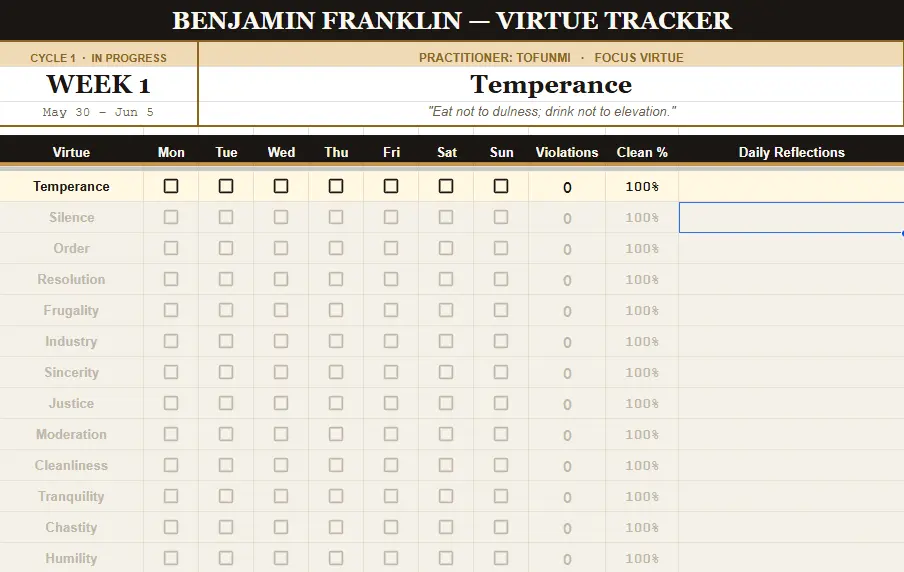
There was a moment when I questioned whether I was procrastinating through productivity. But I built it anyway.
Because making it a thing someone else could actually use was itself part of the point. The post went live. Nobody read it that day. But I published it anyway.
My little secret of “farming Dopamine.”
Need a copy of Benjamin Franklin Virtue Tracker? You can copy mine.
Building the System That Doesn’t Depend on How You Feel
Benjamin Franklin’s Virtue Tracker gave me a framework for measuring character. But I still needed a framework for filling the hours — especially the dangerous hours, the holiday hours, the exhausted-after-a-hard-day hours when the old habits are standing right at the door.
The system I built (and I’m still refining) is what I call the open-closed loop system. And the principle is simple: every task in my day must have a closeable loop — a moment where I can mark it done and feel the authentic completion signal that my brain is wired to reward.
Even large, shape-shifting projects (such as case studies and complex projects) are decomposed into sub-milestones that can be completed within a 10- to 30-minute window (by using a checklist).
What I should have had during the Eid break, and what I’m building now for every future disruption, is what I’d call a context-independent protocol.
A stripped-down routine that activates not because I have somewhere to be, but because I am the kind of person who does this.
Incorporating this, here’s what my new system now looks like:
Wake at 3 a.m. (Identity Reset)
Whatever provisional work I’m doing doesn’t change who I fundamentally am. I am a Marketing Data Analyst. That identity doesn’t wait for a hiring manager to confirm it.
Morning Routine & Work Prep
The ritual that exists whether or not the office opens.
Self-Assigned Case Study
A real data problem I solve and write up as if presenting to a CMO or CTO, then publish to my blog. This is how you build a portfolio without permission.
Franklin Virtue Tracking
The daily review and black-mark log, with one virtue as the week’s primary focus.
Intentional Social Media
Capped strictly at two hours. The structure for this is highly deliberate (see rules below).
Evening Journal
Everything logged. The closure ritual.
Rejection Tracking
Asking for things I expect to be turned down for, and harvesting the dopamine from the ask itself, not the answer.
“When your environment is unstable, you cannot rely on external cues to sustain your habits. You have to become the environment. The system has to live inside you.”
How I Rebuilt My Relationship With Platforms
I deleted my social media accounts years ago. I made that choice deliberately, and for a long time it was the right one.
But I’m back now — not because I changed my mind about how these platforms are built, but because I’ve changed my strategy for navigating them. I know how these platforms work, and therefore, I can now engage on my own terms rather than theirs.
The two-hour window isn’t just a time limit. It’s a structural reorientation of why I’m even there.
The framework runs on three commitments:
The Social Media Reclamation Rules
1. Publish without asking for permission.
Every post goes live as if no one will read it—and that’s the point. The dopamine I’m harvesting is the act of publishing, not the response to it. As long as I believe the post could genuinely help someone who is where I was, that’s enough to hit publish. Creating rewards that the platform cannot withhold.
2. Comment with generosity, not strategy.
A minimum of five thoughtful comments per session. The purpose is not to be seen or drive traffic, but to acknowledge what it costs a creator to put something real into words. Share the dopamine.
3. Track the reach attempt, not the result.
When I ask someone to subscribe, I log it in my rejection tracker. The dopamine fires when I make the entry, not when I check if they followed through. The metric I own is whether I asked, not whether they said yes.
The purpose of this framework is to own my dopamine reward system, intentionally sharing it with creators on the platform rather than handing it over to the algorithm I have no control over.
And yes, I still need to test this to see if it can withstand the pull of addiction.
What Happens When You Start Hunting Rejection
By Day 76, I was deep in what I can only describe as rejection hunger. I had set a goal of 50 rejections for the week (in my week 10 recap). I was at fewer than ten on day four.
So I spent that day moving across platforms with the tracker open, hunting for ways to get turned down.
I started submitting connection requests, applying for roles I was underqualified for on paper, dropping comments without asking an AI to polish my language first, and sharing posts without second-guessing myself.
I was deliberately hunting for the no.
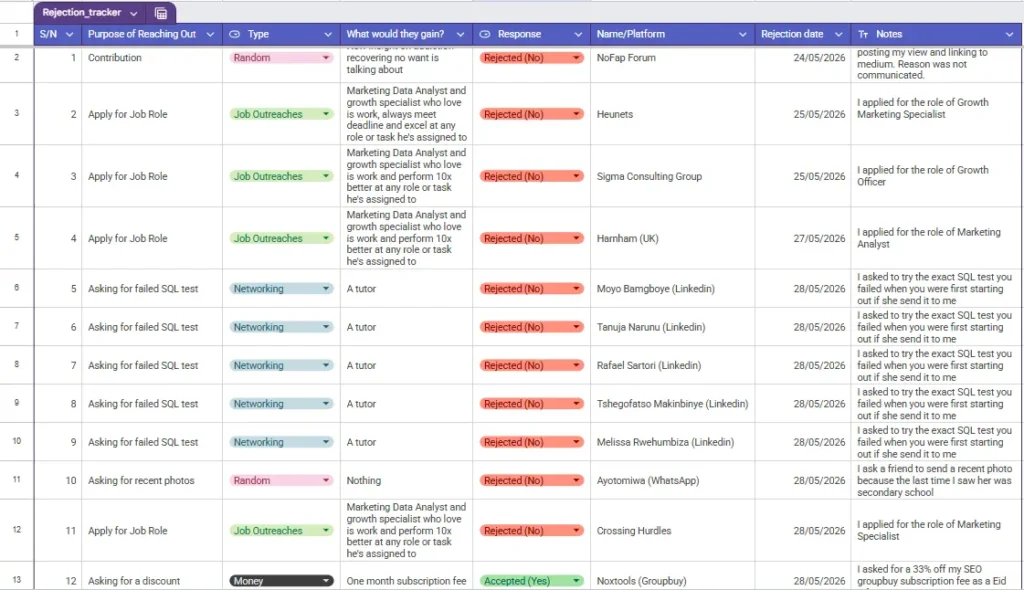
One of those rejections turned into a yes. I asked for 33% off my SEO group-buy subscription and got it. That wasn’t the plan, but that’s the nature of the tracker.
“When you stop treating rejection as a verdict on your worth and start treating it as data about probability, the occasional yes starts feeling like a side effect.”
You become indifferent to the outcome in the way of someone with enough volume in their pipeline that no single response carries too much weight.
On Day 75, that thinking crystallized into something even more concrete: an agency-minded freelancing approach.
My plan is to target major telecommunications retailers in Nigeria whose websites have significant structural and SEO problems.
Instead of spending hours on full audits, I will surface two or three high-leverage issues, pitch them the observation, and ask if they’d like the full analysis. They will almost certainly say no. Perfect.
My plan of farming rejection fasting.
I’m Inviting You for Forty Days
So on Day 79, I walked into a bookshop with a specific intention: to pick up Man’s Search for Meaning by Viktor Frankl and a Benjamin Franklin biography. Neither was available.
The staff — a group of kids — kept demanding I give them another title, unwilling to simply lead me to the section where I could browse for myself. I was about to leave in frustration.
I had already turned toward the door before the shop owner stood up, asked what I wanted, apologized, and walked me to the back himself.
I left with a book I had never heard of: The Purpose Driven Life by Rick Warren.
When I got home and opened the first chapter that evening, it resonated so deeply that I knew immediately I hadn’t made a mistake. It felt like a continuation of what had already been a week full of unexpected answers.
The 40-Day Invitation
Warren wrote The Purpose Driven Life as a forty-day journey designed to be read with someone. I don’t have that person right now, so I’m extending the invitation to you. You don’t have to own the book—if you’re searching for meaning in a season that feels like confusion, you’re welcome to walk alongside me.
Sometimes the person who can actually help you is one layer deeper than the first face you encounter.
The bookshop taught me that again, in a week that had already been full of the same lesson.
What I’m Carrying Into Week 12
The system is not perfect. It was never meant to be. What it’s meant to be is functional under pressure. A structure that holds when I’m tired or tries to creep back into my addiction and survival mode.
Here is what I know at Day 79 that I didn’t know at Day 1:
“Willpower is not a foundation. It’s a finishing material. Systems are what you build on.”
The dopamine you manufacture yourself through deliberate design, marking things done, keeping promises to yourself in small, reproducible increments, is more durable than anything a platform can offer you.
It doesn’t depend on an audience or require validation from a second or third party. It fires when you show up, whether anyone sees you do it or not.
I’m not where I want to be, but I am not the person I was. And in the gap between those two truths lives everything worth building.
food for thought
What part of yourself are you still outsourcing to other people’s opinions, platform metrics, or inherited beliefs you never consciously chose?
Discover more from Rebuild With Intention
Subscribe to get the latest posts sent to your email.