Executive Summary
To build a reliable evening routine for self-discipline, you must first find your “why” and act like the person who has already achieved your goals. Next, use a simple decision matrix to cut out time-wasters, start with tiny habits, and wake your brain up with a quick physical state-breaker immediately after work.
If you have ever come home from a draining shift, collapsed onto your couch, and watched helplessly as hours slipped away into the digital void of your phone screen, you are not uniquely lazy.
You are experiencing a systemic breakdown of willpower.
I know this intimately because I lived it. Coming home exhausted from a grueling 6 AM to 4 PM job, my brain always felt entirely fried.
I would numb that exhaustion by falling into the most dangerous time-wasters in the world: movies, video games, endless social media doom-scrolling, and a deeply destructive addiction to adult content.
It stripped away my discipline, erased my will to live intentionally, and left me entirely without a purpose, vision, or plan.
But turning 29 forced a massive, uncomfortable pivot. I realized I was not getting any younger, and I could no longer afford the heavy cost of my own addictions.
I made a firm decision to rebuild my life from scratch, in a way entirely different from how I lived before.
Here is the exact, psychology-backed, “stupid simple” evening reset checklist I created to bypass exhaustion, hack my dopamine, and build unstoppable self-discipline.
The Breaking Point: Why I Needed to Change My Life Completely
I recently looked back at the notes and journal entries I wrote seven years ago, and a chilling realization hit me: if I were to write a new list of goals today, it would look exactly the same.
Seven years of stagnation is a bitter pill to swallow.
I knew I desperately wanted to leave my customer care job and pivot into a completely new industry as a Marketing Data Analyst.
This field is perfectly aligned with my existing skills, but there was a massive barrier to entry. Official degrees and certifications for this role cost around 12,000 euros—money I simply could not afford.
My only option was to rely entirely on aggressive self-learning.
To pull this off, I started laying systems upon systems. The foundation began in the early hours, and for two solid months, I successfully built and adhered to a strict morning routine.
I utilized the “3 AM advantage,” intentionally carving out an hour between 4:30 AM and 5:30 AM to aggressively build my data analysis skills before heading to my full-time job at 6 AM.
I meticulously collated my course outlines, videos, and practical folders beforehand so I wouldn’t waste precious morning energy on “shadow work”.
The mornings were a massive win, but as I began building my portfolio, I realized morning study simply wasn’t enough.
I needed more time. I needed to conquer the second half of my day. But a massive biological and psychological wall stood in my way: evening exhaustion.
Why You Feel So Tired After Work (And How It Ruins Your Evening Habits)
To fix your evenings, you must first understand exactly why they are broken. By the time I came back from work, I was always tired. I wasn’t necessarily physically broken, but I was deeply stressed and mentally depleted.
When you work a full-time job, run a business, or attend school, your cognitive reserves are drained by 5:00 PM. When your brain is fried, and your stress levels spike, your body desperately craves both rest and dopamine.
Because you have likely spent years feeding your brain instant gratification, it has become accustomed to cheap dopamine.
When your exhausted brain faces a massive, life-changing goal, it sees the task as unmanageable. Instead, it seeks out micro-close-loop-habits that provide an immediate, effortless dopamine hit—like scrolling through social media or watching movies.
We trick ourselves into thinking it’s a harmless break, validating our procrastination by promising to do the “hard work” later.
The Danger of Open Loops
Psychology Concept: The Zeigarnik Effect
In the 1920s, psychologist Bluma Zeigarnik discovered that the human brain remembers uncompleted or interrupted tasks far better than completed ones. In the context of self-improvement, wanting to achieve a massive goal keeps your brain in a permanent “open loop” of chronic, low-grade anxiety—causing your exhausted mind to seek out cheap dopamine just to numb the stress.
When I looked at my real aspirations—link building, outreach, blog writing, and skill practicing—I subconsciously recognized them as advanced, complex tasks that I couldn’t finish quickly.
Because they would leave me in an open loop, I actively avoided them. The fear of not finishing paralyzed me from ever starting.
The Mindset Shift: How to Actually Build Self-Discipline
Before you can draft a schedule or check off a to-do list, you have to fix your mindset. If your psychological foundation is weak or destroyed, any discipline you build on top of it will eventually collapse.
Step 1: Find Your Real “Why”
Identifying your core motivation is the absolute first step. If you do not have a strong “why,” you need to manufacture one immediately. To do this, I recommend the “5 Whys” system.
Mental Model: Drilling to the Root Emotion
Why be a Data Analyst?
To make more money.
Why do I want more money?
To stop stressing about bills.
Why does stressing about bills bother me?
Because I feel like I am failing.
Why do I feel like I am failing?
Because I am not living up to my potential.
Why do I need to live up to my potential?
Because I refuse to be the exact same person I was seven years ago.
Deep down, our goals are rarely about the tangible outcome; they are about a hidden emotion we want to feel or a specific pain point we want to fix.
We think we need the massive goal to feel successful, but the truth is, we can tap into that feeling right now without reaching the final finish line.
Step 2: Act Like the Person You Want to Become
This is where true transformation happens. The only way to close the dangerous open loop of “becoming” is to radically shift your identity.
You must fix your mindset and operate as if you have already achieved your goal.
For example, when I started studying advanced data tools like SQL, Power BI, GA4, GTM, and Power Query, the learning curve was brutal. At times, it became incredibly boring, and I would literally doze off at my desk.
To combat this, I shifted my identity. I stopped viewing myself as a struggling customer care representative.
Instead, I assumed the identity of a senior professional who had just been handed a highly sensitive, difficult project that I had no option but to handle.
I approached every lesson as if my direct supervisor, HR department, and high-paying clients were watching my progress.
I wanted to prove to them that I was worthy of the position and didn’t need to be babysat with basic business communication language.
If your goal is to make a million dollars, realize that a millionaire has certain habits, attributes, and a specific way of walking and talking.
An identity shift allows you to tap into this feeling as you achieve it, ensuring that when you finally reach the goal, your way of life remains rock-solid.
How to Stop Wasting Time: Tracking Your Evening Habits
Once your mindset is calibrated, you must ruthlessly audit your reality. Discipline equals habit, which equals consistency, which leads to growth.
To create a routine aligned with my new identity, I had to analyze what I wanted to do when I got home versus what I was actually doing.
The Harsh Reality
- Watched YouTube while eating snacks (30-60 mins)
- Obsessively checked blog stats & notifications
- Random internet browsing & doom-scrolling (1+ hours)
- Result: 8:00 PM arrives with zero progress.
The Real Aspirations
- Link building, outreach, and guest posting
- Daily journal writing & self-reflection
- Blog writing & content creation
- Practical skills training (SQL, PowerBI)
- Intentional professional networking
The math was horrifying. By the time I finished this cycle of instant gratification, it was already past 8:00 PM, leaving me just enough time to prepare dinner before the night evaporated entirely.
I was making endless excuses. Even my desire to “network” was a trap; it usually just led to doom-scrolling on LinkedIn because I didn’t yet have any professional groups.
Watching movies was just a way to escape into a fictional world and forget my real-world worries.
Using a Simple System to Pick the Right Tasks
To aggressively prune my schedule, I ran my tasks through the Decision Matrix approach. This tool forces you to categorize every task by urgency and importance.
Skill practicing & Journal writingThese are the needle-movers. They happen every single night, no excuses.
Blog writing & NetworkingScheduled blocks. Alternating days: Mon/Wed/Fri for networking, Tue/Thur for writing.
Link Building & OutreachMoved to the weekend. These tasks drain weeknight cognitive energy.
Movies, Extra Sleep & ReadingPermanently deleted. Cheap dopamine has no place in the evening reset.
The result was a lean, hyper-focused architecture for my evenings, centered entirely around skill practice, journaling, blog writing, and intentional networking.
I allocated 2-3 hours specifically to work on myself.
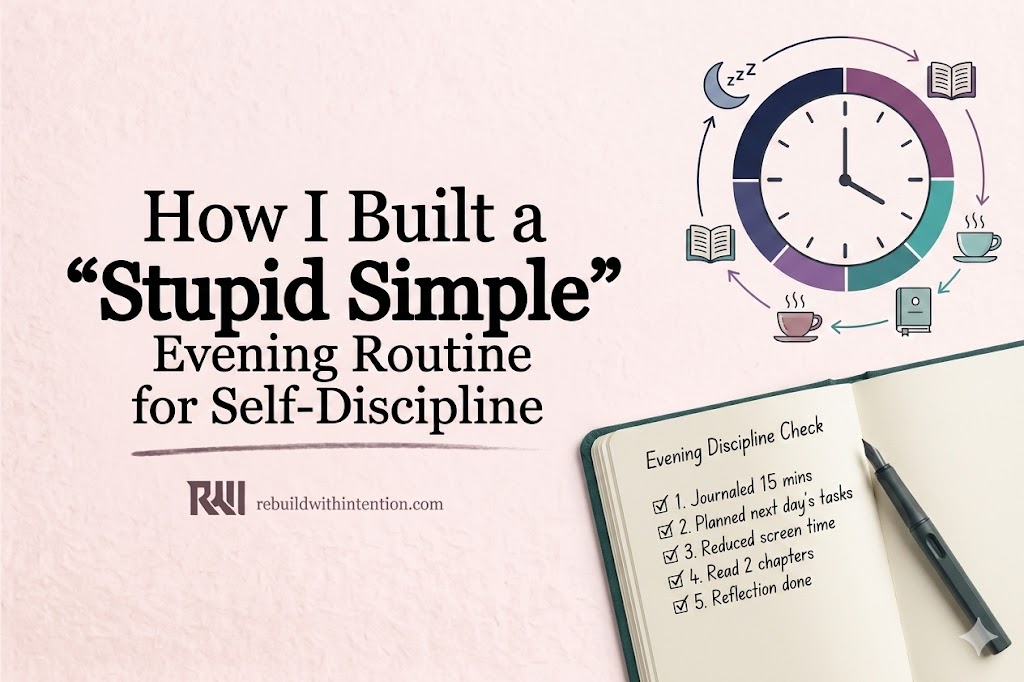
My “Stupid Simple” Evening Routine Checklist
Knowing my retention and memory would be depleted after work, the execution phase had to be completely frictionless.
I mapped out my exact available bandwidth: uninterrupted time from 5:30 PM to 8:30 PM (3 hours), free time from 8:30 PM to 10:00 PM, and journal time from 10:00 PM to 11:00 PM (1 hour).
Here is how anyone can create a “stupid simple” routine:
The “Stupid Simple” Reset Blueprint
Step 1: Unwind & Wake Up Your Brain
- The Transition: Take a shower immediately upon arriving home to physically reset.
- The Physical Friction: Drop to the floor and perform 25+ pushups to failure. This creates an instant closed loop of accomplishment.
- The Timeboxed Indulgence: Eat a late snack while watching a YouTube gameplay video. Box the dopamine in; when the food is done, the video goes off.
Step 2: Focus on Important Work
- Content Creation (1.5 Hours): Pick a pre-planned topic. Alternate days: Mon/Wed/Fri for networking, Tue/Thur for writing.
- Practical Skills (1.5 Hours): Close all distracting tabs. Fiercely guard this time for practicalizing technical skills with Spotify sounds playing.
Step 3: Relax, Journal & Sleep
- The Reward (8:30 – 10:00 PM): Free time to prepare dinner, take a night stroll, or chat.
- The Anchor Habit (10:00 – 11:00 PM): Journal time. Completely non-negotiable, regardless of feelings or motivation.
- Sleep: Lights out, preparing to utilize the 3 AM advantage the next day.
3 Simple Rules to Keep Your After-Work Routine Going
The 3 Rules of Routine Maintenance
- Start With Micro-Disciplines: Break massive goals into tiny tasks so your tired brain can digest and practice them daily without triggering an open loop.
- Apply Progressive Overload: As your routine solidifies, intentionally increase the difficulty of your practice and embrace the errors you inevitably face.
- Document Openly (Not for Clout): Track your growth openly for your own deep reflection, not for social media algorithms. Your mind is not a filing cabinet.
Drafting a routine is only 10% of the battle. Sustaining it requires a specific framework.
Here are the three rules I use to ensure I never fall back into my old ways.
1. Start With Very Small Daily Goals
When you are self-teaching without a mentor, you must manage your brain’s capacity.
Do not force your tired brain to stare at a screen for two hours straight. Break massive goals into micro-disciplines.
I don’t track my productivity just by targeting hours; I track it by what I have actually learned.
If you successfully learn how to split a column or merge a query, or if you learn how to use the Eisenhower matrix, you are doing well.
Digesting and practicing just one or two small concepts gives you the instant dopamine you need from finishing a small task.
2. Slowly Make Your Tasks Harder
A static system eventually becomes stagnant. Once your evening routine finally becomes an automated habit, you must increase the dose.
Challenge yourself to put into practice what you’ve learned. You are bound to face errors, and that is the entire point.
We learn by making mistakes.
3. Track Your Progress for Yourself (Not for Social Media)
Finally, do not keep your growth journal locked inside your head. Your head is not a filing cabinet.
You must document your journey openly, but do not expect likes or try to monetize your new habit immediately.
When you document for internet clout, you focus only on the harvest, not the hard work. Your documentation is strictly for your own reflection.
It exists so you can look back and definitively prove to yourself where you are coming from, where you are now, and exactly where you are going.
By identifying your true “why,” acting like the person who has already won, and building a stupid simple system that respects your exhaustion, you can transform your evenings into the launchpad for your new life.
Discover more from Rebuild With Intention
Subscribe to get the latest posts sent to your email.