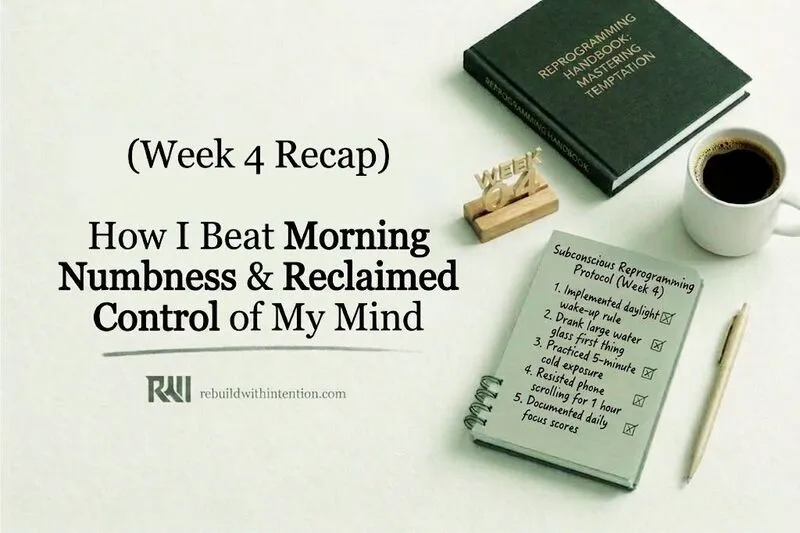
The secret to overcoming morning numbness and mindless autopilot is establishing a micro-habit morning routine. Breaking your morning into rapid, achievable tasks—like alternating pushups with basic hygiene and short learning sessions—provides instant dopamine, tracks daily progress, and establishes unstoppable momentum.
If you have ever felt entirely powerless, trapped in a toxic environment you cannot control, and battling the heavy, lingering consequences of past destructive habits, you know exactly how exhausting this predicament feels. It drains your soul before the day even begins.
But rather than letting the intense frustration drag me back into the dark trenches of my past dependencies, I leaned entirely on a simple, unbreakable daily system to keep me anchored.
Today, I am pulling back the curtain and sharing exactly how this exact routine cured my morning numbness, kept me completely clean for 30 consecutive days, and gave me back my ultimate sense of purpose.
Fighting the Environment: The Midnight Lamentations

Rebuilding your life from rock bottom is not glamorous. It is deeply uncomfortable, and sometimes, it is infuriating.
The other night, I was forced to stay awake well past 11 PM after a long, bone-crushing day of work. I desperately needed to rest my head, but unfortunately, I couldn’t. My sleeping space was completely hijacked by noise.
This was not the first, fifth, or twentieth time. It happens over and over again. The only time I have absolute peace and silence is when I am completely alone.
- I am sharing a room with thoughtless kids who have absolutely zero situational awareness. They were never taught how to respect shared spaces.
- They blast explicit videos and comedy skits on loudspeaker, laughing hysterically at 10 or 11 PM.
- They talk to their girlfriends for over three hours on loudspeaker between 11 PM and 1 AM.
- Because of my past habits and my brain’s current phase of rewiring, I am hypersensitive to unwanted noise. I cannot survive without my earphones, but my eardrums can only take so much physical abuse.
What is even more painful is the stark realization that I cannot change my location because I am broke. Getting an apartment in Lagos is not what I can afford right now.
There is a stoic saying: if you can change a predicament, do so; if you can’t, don’t complain. But when you are trapped, feeling completely powerless, the regret of what your past dependencies have cost you hits harder than ever.
This frustration spilled over into the next day. Boiling with anger, I accidentally set my alarm to PM instead of AM. It didn’t ring. I woke up at 5:30 AM in a complete panic. My time was already gone.
I couldn’t do my morning routine. I couldn’t access my journal because it was stored on my computer, and the power was out. I missed my daily data analysis class. Out of my mandatory 100 pushups, I only managed 55.
I am constantly praying for an apartment of my own. In this quiet sanctuary, I can rest my head after long working days without disturbance, without cursing, and without boiling over with anger.
I am asking God for divine favor and the speed to shape my environment, rather than being forced to adapt to a predicament over which I have no control.
The Anti-Autopilot Formula: Engineering Dopamine

Despite the environmental setbacks, I refuse to fold. By Day 25, my body was stiff when I woke up, but my habits had become fully automatic. My brain actually knows when it is missing out on the routine. This is the turning point of habit formation.
Here is exactly why establishing a rigid morning routine is the ultimate hack—the absolute non-negotiable foundation—for anyone rebuilding their life from scratch, navigating addiction recovery, or simply trying to level up:
1. It Cures Morning Numbness
Most of the time, when I wake up, I become completely numb for a second. My brain boots up and says, “Oh, we are alive today. Thank God. So, what should we do first?”
In the past, my brain would immediately start aggressively seeking out the easiest, most destructive dopamine reward—like retreating into adult content, engaging in a meaningless hookup, or scrolling through social media.
But with a rigid routine and a predetermined cue already available, I don’t need to seek out artificial dopamine. Finishing my routine, one micro-task at a time, provides a massive, healthy sense of completion.
2. It Kills the Mindless Autopilot
Believe me when I tell you this: without a morning routine, your mind will go into autopilot in a matter of minutes.
I always arrogantly thought I was in control of my mind, but I wasn’t—not until I anchored myself to a routine.
When I woke up on Day-25, I didn’t immediately jump into my routine. Instead, I started looking for a new SQL data analytics course after finishing my Excel for Power Users course.
Because I am sourcing free tutorials one by one, I fell into a rabbit hole. I went completely on autopilot. Before I even realized what was happening, 30 minutes had vanished. I snapped out of it, immediately closed the tab, get ready and got to work.
Mindless Autopilot is the enemy of intention.
3. The Power of Open-Closed Loops (Instant Dopamine)
A morning routine gives me a sense of completion through open-ended loops that take only a few minutes to close. This is my absolute secret weapon for navigating my day.
Normally, the average person starts their day with 30 minutes of social media to catch up on what they missed. This floods the brain with cheap, unearned dopamine. By the time they get up to brush their teeth and go to work, their motivation is already depleted.
I completely inverted this process. I break my routine down to give me earned instant dopamine.
The 100-Pushup Dopamine Protocol:
I made this routine stupidly simple, so it never overwhelms me, even if my brain tries to trick me into thinking I lack the physical strength.
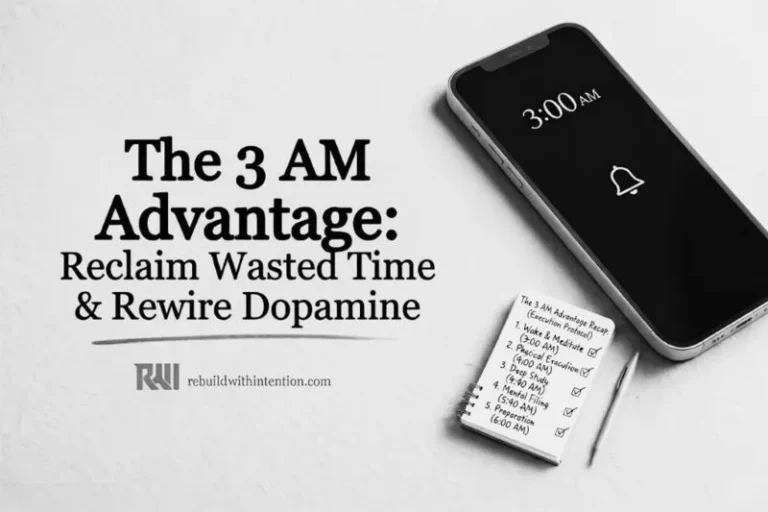
- Step 1: Wake up and instantly hit the floor for 20 pushups.
- Step 2: Walk to the restroom, finish, and immediately drop for 20 pushups.
- Step 3: Brush my teeth, rinse, and execute another 20 pushups.
- Step 4: Take a cold/lukewarm bath, dry off, and complete 20 pushups.
- Step 5: Sit down for a highly focused 30-50 minute data analytics learning session.
- Step 6: Finish the study session and knock out the final 20 pushups.
Look at how many critical life-building tasks I have completed in less than two hours. Unless you try this exact framework yourself, you cannot possibly understand the intense feeling of fulfillment you get from checking off 10 micro-goals in a short period.
4. It Makes Growth Trackable
If you plan to become a writer, an elite developer, or to lose 50 pounds, and you do not have a routine, a day will inevitably come when you look in the mirror and say, “What am I even doing?”
Routine makes your growth tangible. If you finish your system every single day, you know with absolute certainty that you are moving forward.
5. It Enforces Time Consciousness
Routine makes me violently protective of my time. I don’t lose hours to the void anymore because I am highly conscious of every ticking second. I use my work time strictly for work, and I use my “me time” strictly for me.
In the past, my “me time” was abused with video games, movies, and destructive urges. Now, I am hyper-aware of where my energy is flowing.
Systemizing the Mind: Moving to Google Keep & Tasks on PC

As you start to build again, your systems need to change and improve. Right now, I am using four laptops. One is for my personal use, one is for my job, one is at home for writing, and one is for my side job where I manage customer bills.
The bottom line is that having separate documentation folders scattered across different operating systems was becoming mentally overwhelming. I was drowning in disorganized text files.
So, I made the executive decision to migrate my entire journaling system over to Google Keep. For right now, this works flawlessly.
These journal entries are raw, bleeding thoughts. Writing them in Microsoft Word triggers my perfectionism—I start editing, formatting, and doing structural corrections while I should just be writing. I mean, I just want to pour the raw thoughts out of my head without friction.
So, I dedicated a morning (Day-26) specifically to moving all my journals to Keep. Streamlining your digital environment is just as critical as cleaning your physical room.
HALT: Surviving Weekend Burnout and Mental Friction
The weekend finally arrived, and my mind was completely exhausted. I had absolutely no energy left, yet I still pushed myself to stick to my pushup routine.
Earlier in the day, I had been assigned a complex billing task that demanded intense concentration for four straight hours, leaving me glued to my chair. By the time I wrapped it up, I was seriously starving.
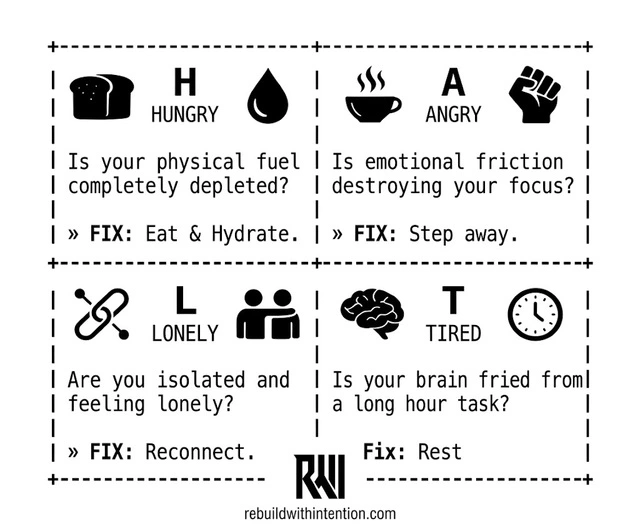
This is where psychological frameworks save your life. My brain immediately flagged the HALT system: I was Hungry, Angry, Lonely, and Tired.
When you are in the trenches of recovery and rebuilding, the HALT state is your most dangerous enemy.
With how tired and stressed I was, I am 100% certain that if not for my rigid daily routine and my awareness of the HALT triggers, I would have either entirely given up on my commitments for the day or completely relapsed into my old, destructive coping mechanisms.
I sat down and analyzed exactly why I felt this burnout approaching. Here are the root causes and how I am attacking them:
External Factors (Lack of Time Control):
I wouldn’t experience this level of burnout if I had complete autonomy over my time. But because I am working for a boss who pays me, I have to surrender some control.
To survive this, I must consciously manage my mental stamina. I cannot afford to over-leverage my brain to solve every single task at 100% intensity on the go. This is a mental health survival tactic; I cannot afford to let my mind get disturbed and destabilized again.
No Dedicated Reminder App (Friction):
I don’t currently have a reliable personal smartphone. For someone in active recovery who doesn’t have a quiet space of their own, a mobile device is actually a necessary tool—not for mindless scrolling, but for capturing ideas, setting rigid reminders, and learning on the go.
Right now, I have to hold all my tasks in my head until I can physically log onto my laptop to record my progress. To bypass this friction, I am pivoting back to the traditional method: carrying a physical pen and paper next week.
The Expectation Loop (Social Friction):
During my darkest days, I completely isolated myself from everyone. I didn’t expect messages, so I never checked for them.
But now that I am stepping back into the light and reconnecting with people, I keep finding my brain wandering to WhatsApp, constantly checking to see if a specific person has messaged me.
Waiting on others adds massive friction to my brain. It breaks my focus when I should be writing. I have to actively kill this expectation loop to protect my peace.
The Evolution of a Purposeful Blogger: Escaping the Mediocrity Trap
Today marks the beginning of the fourth week since I chose a life of strict purpose over a life of drifting mediocrity. Seeing my raw enthusiasm for this documentation process, I know my spark is truly back.
But the journey to Rebuild With Intention was not paved with immediate success. It was built on the ashes of failed projects and the harsh realization that chasing quick money without a foundation always leads to ruin.
It wasn’t always like this. I started my first blog, gripinsight.com, back in 2020. I had a massive vision of making my first $10,000 online, but that blog did not survive. It died a slow, quiet death because I only had a big vision without doing anything noteworthy to back it up.
The “Make Money Online” Mirage
When you are desperate to escape the trenches, you look for the fastest ladder out. For me, that was the “make money online” niche.
- I spent an entire year just changing the blog theme, over and over, until the domain finally expired.
- My first ever blog post was literally titled “How to make money online,” but it was entirely curated from what I had heard and watched on YouTube. I was writing about generating wealth when I hadn’t made a single dime myself.
- Many beginner bloggers and YouTubers make this exact, fatal mistake. They push methods without a conscience. As long as it brings money into their pockets, they don’t care whether the method actually works for the reader.
In the end, my big dream did not make any money. I didn’t even have enough money to pay for my website and domain for the second year. It was a hard hit to my pride, but I learned an important lesson about being true to myself.
My Second Blog and the SEO Penalty Heartbreak
I refused to quit. I built my second blog, griprecap.com, in January 2021. This was the year I discovered my mentor, Adam Enfroy.
I was one of his earliest followers, consuming all of his content literally before he even made his massive pivot to YouTube. That blog taught me everything I know and still apply to this day about SEO and affiliate marketing.
- I was young, completely broke, and didn’t have the budget for massive outreach campaigns or hiring elite writers to create comprehensive posts.
- I had to do absolutely everything myself: the exhaustive writing, the grueling manual link building, the site design, and the technical troubleshooting. It was a staggering amount of work.
- But the grind paid off. In just four months, I built that blog to a Domain Authority (DA) of 40 and started ranking on the first page of Google.
- I was so proud that I shared my step-by-step strategy on our private Facebook group.
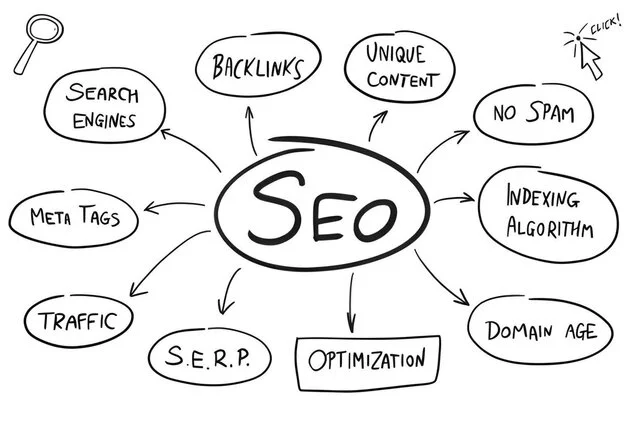
However, my strategy was flawed. I couldn’t really define the blog’s niche. I was just chasing metrics—picking keywords with high search traffic and low competition, and publishing articles ranging from job hunting to time management to tech to making money online.
Then came the fatal error. I received a guest post offer. It was free money—the company paid me around $120. But shortly after I accepted and published it, Google penalized my blog.
Some of my hardest-working articles were completely stripped from search engine results pages (SERPs). I eventually sold the blog while it was still serving ads and used the capital to fund another project.
Why “Rebuild With Intention” is Different
I have been in the SEO trenches since 2019. I’ve created other blogs, managed sites for high-paying clients, and offered premium link-building services based on that hard-earned experience.
No matter what other hobbies or projects I pursue, I always come back to blogging because there is something deeply profound about creating text that “people want to read.”
But this time, I am not blogging out of passion. I am not blogging based on search intent. I am not blogging solely based on profit. I am blogging based on raw documentation.
I am overcoming the trenches and sharing exactly how. I am laying out my exact problems and the raw, unpolished solutions I use to fix them. My challenges, my failures, my mindset shifts.
You are constantly told by gurus to “find a problem people are facing, find a solution, and sell it to them.” Because of this, you must be incredibly careful about the kind of information you digest online.
Most of the advice out there is not based on first-hand experience; with my years in the industry, I can boldly tell you that their “proof” is easily fabricated.
This blog is my actual rebuild log. No fabrications. Just the aggressive pursuit of discipline.
Avoiding the “Guru” Trap: Keeping the Main Thing the Main Thing

As I keep writing about my journey, I’ve started to notice a dangerous shift in how I think. What began as just a simple plan to document my experiences is slowly turning into a bigger idea about becoming successful online.
Because of my SEO background, I am instinctively shifting this blog’s focus away from pure journaling and toward gaining recognition. I find myself taking on the roles of Writer, Outreach Manager, and Off-Page SEO Specialist at once.
But I had to stop and ask myself a very serious question:
- Do I really want to do this right now?
- Do I want to go to war for Google page rankings?
- Do I want to stress over traffic metrics on a blog that is barely a month old?
The answer is no. Rushing the process will just make the rebuild miserable.
Take it slow, Elias. You do not have to prove anything to anyone. This is a documentation blog. Let’s keep it that way. I do not need to stress about massive readership right now, because the exact right person—the person genuinely IN NEED of this specific advice—will inevitably find this blog.
30 Days Clean: The Metrics of a Purposeful Life
Today marks the 30th day of rebuilding my life with absolute, aggressive intention.
When you align your actions with your goals and completely eliminate the noise, the results speak for themselves. Over the last 30 days:
- I have been absolutely clean. No PMO. No meaningless habits.
- I have a relentless sense of direction.
- My mind has not been on autopilot for a single day.
- Every single day is lived with purpose and intention.
- I follow the exact same routine every morning. (If a system works perfectly, why change it? Just repeat the execution).
- I have not played a single video game or watched a single movie.
- I have zero active presence on social media (other than the accounts I created a few days ago purely to distribute this blog’s content).
Let’s talk about my YouTube consumption. Over the past 30 days, I have spent approximately 7 hours on YouTube.
- 3 hours were spent watching an incredibly detailed historical documentation of Christ (spread across two days).
- 4 hours were spent watching high-level gameplay from my favorite Call of Duty Mobile gamers to decompress.
- The longest I spend on any video is 30 minutes. When the video is done, I immediately close the website.
- No YouTube Shorts.
- No auto-playing the next video.
I tried to find the native Google dashboard settings to officially display this minimal watch time as proof, but I couldn’t locate it. Regardless, the mental clarity I have achieved from severely restricting algorithmic dopamine is unmatched.
Key Takeaways: The Blueprint for Your Rebuild
If you are reading this, and you are currently suffocating in your own trenches—whether it is a toxic living situation, a dead-end job, or a cycle of addictions you cannot seem to break—I want to leave you with the three core pillars that have kept me alive over these last 30 days.
1. Your Becoming is Greater Than Your Doing
Not all days feel the same. There are days like yesterday, when I had to skip dinner, leaving me physically weak and struggling to hit my pushup numbers. There are days when my brain is fried from client work.
But you must realize that the act of showing up—the person you are becoming by refusing to quit—is infinitely more important than the perfect execution of the task itself.
2. The “Never Miss Twice” Rule
If your environment makes you feel overwhelmed, or if you become very tired and go to bed early without finishing a project, forgive yourself immediately.
I closed my laptop and went to sleep early the other night because I knew I had worked hard and deserved some rest. But you must adhere to the golden rule of rebuilding:
Don’t miss two times in a row. Missing once is okay, but missing twice is the start of a new, bad habit.
3. Tomorrow’s Victory is Planned Tonight
If you want to have a perfect, high-momentum morning, it strictly starts with the night before. You cannot wake up to chaos and expect to engineer discipline on the fly.
You must know exactly what your first micro-task is the second your eyes open.
My plan for the next 30 days is simple: I will not stop my routine for any reason. I am going to master the mundane. I will only add one new habit to my plate.
I haven’t decided exactly what it will be yet—perhaps I’ll actively practice my verbal communication so I can speak confidently without searching for words, or perhaps I will increase my physical training volume to forge an even stronger physique. Whatever it is, I am going slow, but I am going incredibly steady.
Be intentional. Rebuild your life. I will see you in the next log.
Discover more from Rebuild With Intention
Subscribe to get the latest posts sent to your email.