As a Marketing Data Analyst, my daily tasks revolve around service level agreements, KPIs, latency thresholds, and conversion metrics.
If our marketing performance drops by just 0.5%, my team gets notified, we start looking into the problem, and we fix it to make the system work better.
Recently, I had a brutal realization: I handle millions of dollars of corporate data accurately, but my own life felt disorganized and uncertain.
My finances were like a bucket with holes in it. I only reached out to friends when they checked on me first. My personal goals felt unclear and caused me anxiety.
If my life were a business, I would have been fired for gross negligence.
I didn’t want another generic motivational speech. I needed a diagnostic tool. I wanted a life audit template that worked like business software—strict, truthful, and deeply revealing.
Auditing your life is about understanding yourself better. It is about creating a system that supports you when your motivation runs out, so you can stop guessing and start taking executive control of your reality.
The Willpower Trap: Why You Can’t Keep Track of Current Habit
The reason why your current personal growth plan is likely to fail is that it relies on Willpower.
Willpower isn’t a permanent quality; it’s a mental resource that can run out.
Every time you make a decision, control your feelings, or do something uncomfortable, your willpower gets weaker. By 4:00 PM on a Tuesday, after handling tough clients, dealing with office issues, and going through traffic, your willpower is almost gone.
But this is when self-help experts expect you to sit down and fill out a complicated goal-setting worksheet with fancy pens and colorful highlighters.
That’s not realistic.
Using a generic habit tracking template only makes things harder. At the end of the day, when you face a blank box asking, “How did you overcome your fears today?” your tired mind doesn’t know what to do.
You don’t want to face fears; you just want to enjoy a nice meal and relax.
The big mistake in traditional self-improvement is thinking that feelings should dictate actions. You wait until you feel “ready” or until you are in the right mood. But facts don’t care about feelings.
In software engineering, if a system needs too much manual input, it fails. People make mistakes. People get tired. That’s why we automate processes and make things easier.
To improve your life, you need to reduce the choices you have to make. Create a system that understands you will be tired and unmotivated sometimes.
You don’t need to work harder; you need to make the right actions simpler. You need a strong framework that turns your feelings into clear, actionable steps.
A Simple Mental Health Assessment to Clear Your Mind
To understand why the Executive Life Audit is effective, it’s important to think about how our brains work. I compare the human brain to a very powerful computer with 2 GB of RAM.
Have you ever felt bothered by an unanswered WhatsApp message or a particular chore you haven’t finished? But once you take care of it, you quickly forget about it?
That feeling is called the Zeigarnik effect. Your brain clings to unfinished tasks, keeping them in your mind and draining your energy.
When your life feels disorganized, you may have many of these unfinished tasks weighing on your mind.
- Have I saved enough money this month?
- Am I eating too many sweets?
- Should I call my mom?
- I want to read that book.
- Am I happy with my job?
This constant thinking can lead to tiredness and stress.
Doing a time management audit isn’t about fitting more work into your day; it’s about finishing these mental tasks.
By writing down how you spend your time, you take that mental load off your brain.
But it’s not just about time. We also need to balance our dopamine levels.
Today’s world is full of distractions that give quick dopamine, like scrolling through social media, eating junk food, or reading sensational news.
These ups are usually followed by big drops in energy, leaving you feeling tired and unmotivated. A good audit system helps you avoid this emotional rollercoaster.
When you take the time to do a mindset assessment or a mental health assessment, you are training the part of your brain that plans and thinks logically to take control.
By simply writing down the facts—without judging or panicking—you help ease any emotional resistance.
If you didn’t go to the gym today, it doesn’t make you a failure; it just means you have a 0 in that category.
A zero is not a bad thing; it’s just a fact.
When you take the shame out of tracking your habits, it becomes easier. You finish those mental tasks, freeing up your brain to actually get things done instead of just worrying about them.
Life Audit Template: The 8-Dimensional Framework
You can’t improve what you don’t track.
A real assessment of your life doesn’t only focus on how much money you earn or how well you sleep. It looks at the entire picture of how different parts of your life connect with each other.
I divide life into 8 main areas for growth.
1. Career & Output
This isn’t just about your job title. It’s about how much you can achieve and make a difference. Are you getting better at your skills, or just working for money?
We look at how much time you spend on important work compared to busy work, like meetings and emails. If most of your week is spent in meetings or sending emails, that’s not good.
Here’s a simple way to think about your work: If I keep working like this for 5 years, will I get better at my job and earn more money, or will I stay the same?
2. Finance & Capital
We take the feelings out of money. It’s just a way to create freedom. I’m not interested in how much money you make; I want to know how fast you’re spending, how quickly you’re saving, and how long your money will last. We keep a close eye on every dollar coming in and going out to make sure you are using your money in a way that matches your true values, not just what you feel like doing.
3. Health & Biological SLA
You need to understand how your body works. Your body is like a machine that helps your mind work well. If the body gets weak, everything else can fall apart.
So, instead of just checking whether you feel good, you should also consider factors like your resting heart rate, how well you sleep, how much water you drink, and how often you exercise.
4. Personal Growth Plan
Personal growth is a way to improve your life little by little. What new ideas are you learning? It’s not just about reading books; it’s also about using what you learn in your life. Are you trying new ways to think?
This is very important for reaching your long-term goals—changing your dreams into real skills that you can see and grow.
5. Spiritual & Values Assessment
No matter if you are religious, unsure, or focused on ideas, it’s important to have something to guide you. This is your values assessment tool.
Are your daily actions matching what you truly believe? When there is a gap between what you care about and what you actually do, it can lead to feelings of sadness or unhappiness.
We pay attention to how often you take time for quiet moments, prayer, or meditation.
6. Relationships & Network
Your relationships are like a network. Are they strong connections that help you, or are they causing you stress and wasting your energy?
The life audit template helps you to keep track of how you invest in your relationships. Did you reach out to someone first? Did you make time for your friend or partner?
Instead of waiting for others to keep things going, we take charge of our social connections.
7. Mental/Emotional Baseline
This is your system health dashboard. You can use it to track mood volatility, stress triggers, and emotional regulation.
Instead of passively suffering through a bad week, you can use the life audit template to proactively define how you will respond to stress. With it, you can track the days you successfully interrupted a negative cognitive loop.
8. Recreation & Renewal
Hustle culture pushes you to work long hours. But good systems show that keeping a server working all the time leads to big problems.
Taking breaks isn’t just nice; it’s something you have to do to stay healthy.
Your life balance worksheet isn’t only about sharing your time equally; it’s about making sure you have plenty of good, screen-free time to relax. If you don’t plan your downtime, you might end up very tired and burnt out.
Download Your Free Life Audit Template
I want to share something important with you about self-improvement tools that many people use. Most of them have a big problem: Free-text fields.
When you get a life audit template for free from someone online, it usually looks nice but asks you to “write down your feelings.”
Writing about how you feel every day can lead to big problems.
When you’re tired, the last thing you want to do is write a lot about your day. It’s hard to keep doing this every day.
If tracking your life takes more than 90 seconds each day, you probably won’t keep it up for more than three weeks.
That is why I developed the Zero-Text Architecture.
Master Performance Dashboard
Interact with the dashboard below. Toggle between months to see how real-time executive data, KPIs, and the Balance Matrix automatically update based on simulated logs.
Overall Life Score
—
/ 10.0Aggregate system health
Top Performing Area
—
Highest sustained average
Needs Attention 🚨
—
Silent recession detected
The System Balance Matrix
An automated visualization revealing your current equilibrium across all 8 core growth dimensions.
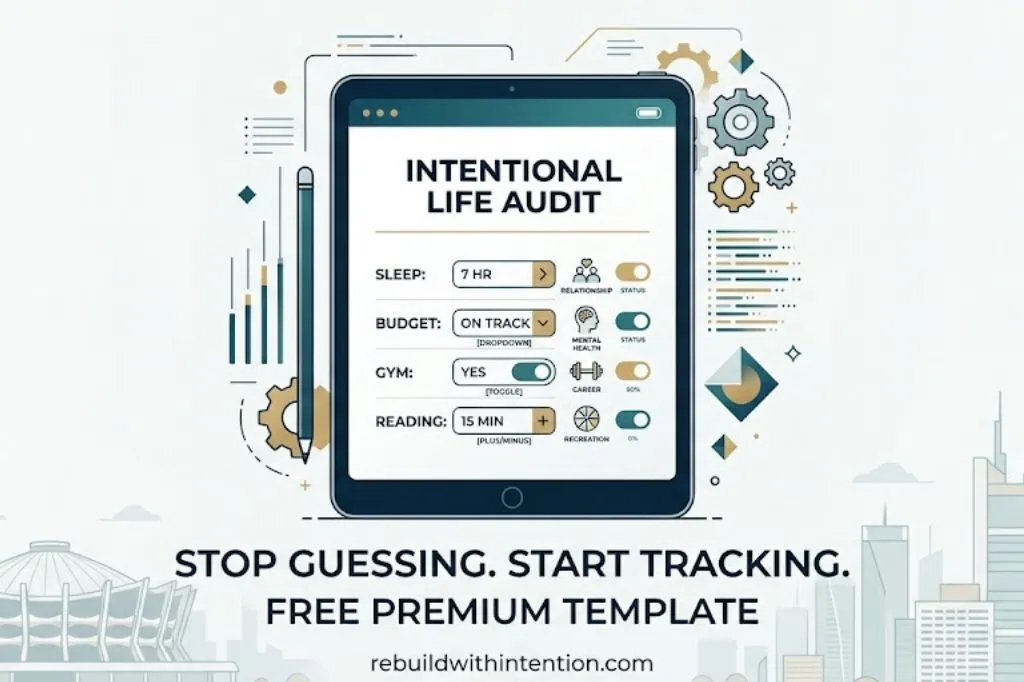
A premium tracking system must operate like a clean, validated database. It relies strictly on:
- Booleans (True/False): Did you work out today? Yes or No.
1or0. - Integers (Numbers): How many hours of deep sleep did you get?
7. - Validated Dropdowns: What was your primary mood today? [Select from list: Focused, Anxious, Neutral, Energetic, Lethargic].
By using strict data validation and automated data tracking, we ensure data consistency. You don’t have to think; you just have to click.
You open the dashboard on your phone while brushing your teeth, tap five dropdowns, toggle three switches, and you are done.
Because the inputs are strictly formatted, the outputs become incredibly powerful. Over 90 days, this zero-text data aggregates into pristine, automated charts.
You become the architect of your own life. You stop being a victim of your circumstances and start analyzing your patterns.
You don’t need more motivation. You need better data. It’s time to build the infrastructure.
👇 [ CLICK HERE TO COPY MY FREE PREMIUM LIFE AUDIT TEMPLATE ] 👇
(Note: Clicking the link will prompt you to make a copy of the premium life audit template in a Google Sheet directly to your own Google Drive. No one else will have access to your private data).
Recommended Post: Google Sheets Habit Tracker Template: Free Download
Discover more from Rebuild With Intention
Subscribe to get the latest posts sent to your email.