By default, our brains are wired to seek instant gratification. This isn’t just a genetic anomaly; it is a survival mechanism that starts right from birth.
When a baby cries, their needs—whether for food, warmth, or comfort—are instantly met. As the child grows, many well-meaning parents go out of their way to ensure their child never lacks anything, often providing for them before they even have to ask.
While this level of care comes from a place of deep love, having every whim instantly satisfied can unintentionally rewire a developing brain.
The real problem doesn’t lie in childhood comfort, but rather in the failure to properly introduce delayed gratification during the critical teenage years.
Personally, I didn’t have the privilege of having all my needs met as a teen.
Consequently, when I became an adult with more freedom, seeking immediate relief and reward became an addiction. Trying to satisfy my urges the exact moment I felt them created a destructive loop.
The only way I was able to overcome this addiction to instant gratification was by living with fierce intention and building a bulletproof mind.
Following the unchecked path of instant gratification is dangerous and destructive.
A universal law states that there is a time for everything: a time to plant and a time to reap, a time to be born and a time to die.
Every season has its own unique purpose. When we try to cheat time and grab the reward before doing the work, we set ourselves up for failure.
In this article, we are going to explore the profound differences between instant and delayed gratification, the behavioral psychology behind our choices, and how mastering the art of waiting can transform your personal development, emotional regulation, and financial destiny.
Instant Gratification vs Delayed Gratification
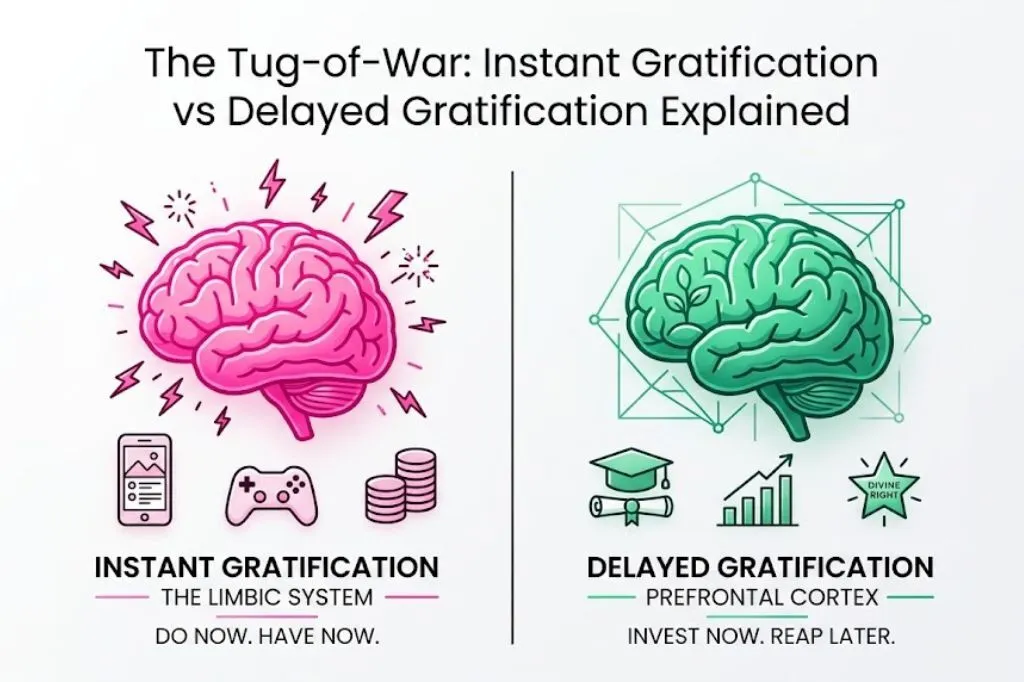
To win the tug-of-war in our minds, we must first clearly define the two forces at play.
What is Instant Gratification?
Instant gratification means having your desires, urges, or needs met at the exact point in time you feel them. It is the desire to experience pleasure or fulfillment without any delay or deferment.
Instant gratification goes far beyond meeting basic needs, like food or water. In the modern world, it extends to money, intimacy, attention, and entertainment.
These are quick rewards that offer short-term pleasure but rarely last. Because they require no effort, they build no character.
On a financial level, a typical example of instant gratification is falling for “get-rich-quick” scams or shabby affiliate marketing schemes that promise wealth without work.
People chase these because the brain wants the reward of wealth without the friction of labor.
What is Delayed Gratification?
Delayed gratification, on the other hand, is the ability to resist the temptation for an immediate, smaller reward in order to receive a larger or more enduring reward later.
This is usually a self-taught trait and requires immense discipline.
Delayed gratification are long-term rewarding needs. The results last because the journey required to achieve them changes who you are as a person.
A typical example is the patience development required to learn a high-value skill, such as coding, writing, or building a successful YouTube channel from absolute zero.
It requires you to show up, put in the work, and see zero results for months or even years before the breakthrough happens.
The Neuroscience Behind the Choices
Decision Making and Brain Activity
Every choice we make branches out into another choice, creating a complex tree of decisions that dictates the trajectory of our lives.
Our modern system is heavily designed to engineer our decision making and brain activities to favor the immediate.
When we are hungry, our brain automatically signals us to eat. When we are thirsty, we drink. But society has taken this biological baseline and applied it to our life paths.
When a child is born, the default societal path is for parents to provide shelter, send them to school to memorize facts, have them become an employee who works for the system.
They get married at a certain age, have kids, and continue the loop.
It takes deep understanding and self-learning to realize there is a life beyond this automated, safe path.
Neurologically, our brains are in a constant battle between the limbic system and the prefrontal cortex.
The Battle for Your Choices
The Limbic System
Primitive & Emotional- Demands instant rewards
- Minimizes loss and avoids pain
- Seeks the path of least resistance
Prefrontal Cortex
Logical & Analytical- Handles complex planning
- Values long-term goals
- Tolerates short-term friction
We naturally want to minimize loss, mistakes, and bad choices, so we take the easy way out—the path of least resistance that guarantees basic survival.
At age 19, I made a conscious decision not to use my certificate to look for a traditional job. Instead, I came online with the purpose of “making money online.”
Because I stepped off the standard path and didn’t have a mentor to look over my shoulder, it took significant cognitive delay, countless sacrifices, and about six years to make a tangible, sustainable income online.
My prefrontal cortex had to constantly override my limbic system’s desire to quit and get a safe, instantly paying job.
Emotional Regulation: Instant vs Delayed Responses
The environments we grow up in heavily regulate our emotions, often conditioning us to seek instant over delayed responses.
A common example of poor emotional regulation is getting angry, furious, or hurt when you talk to someone and they don’t answer you immediately. Our ego takes a hit.
When I was younger, I hated delayed responses with a passion.
I would even go to the lengths of deciding never to talk to a person again simply because I couldn’t handle the temporary feeling of being neglected.
Similarly, if a desire arises, we want it fulfilled immediately because unfulfilled desires keep our brains in an “open loop.”
An open loop creates mild psychological discomfort.
As humans, we must learn to regulate our emotions and tolerate this discomfort to prioritize long-term rewards.
Striving for an instant response clouds judgment.
This psychological loophole is exactly what sales experts target.
They give you no room for a delayed response, introduce a false sense of urgency, and plant the Fear Of Missing Out (FOMO) to trigger your limbic system into buying.
Expert Tip: The 24-Hour Rule
The next time you are asked a high-pressure question or feel the urge to make a significant financial decision, enforce a one-day interval. Close the page, sleep on it, and return the next day. If you still want to make that buying decision with a clear head, you probably won’t regret it.
The Role of Society and Culture in Instant Gratification vs Delayed Gratification
The Instant Gratification Culture
Today’s society plays a massive, undeniable role in normalizing the instant gratification syndrome. Everything has been digitalized and made frictionless with AI systems and high-speed internet.
The natural dopamine our ancestors received from hard work, building, and physical connection has now been replaced by artificial, unearned dopamine.
Society has normalized doom-scrolling on social media, binge-watching television series, and losing days to video games.
I was reflecting recently, looking at the lives of adults aged 40 and above and comparing them to teenagers and young adults aged 17 to 30.
The Generational Patience Gap
Behavioral metrics highlighting the shift toward instant gratification between Digital Natives and older adults.
There is often a frightening lack of correlation between work ethic and patience. This contrast makes me genuinely wonder about the fate of the upcoming generation.
A few months ago, I started rebuilding my life with intention. During this time of clarity, I started seeing my past self in others.
I discovered just how much damage instant gratification has caused now that society has labeled it as “normal.”
We now experience at a younger age what previous generations didn’t experience until full adulthood.
With just a few clicks, massive adult sites are available to satisfy sexual urges without the need for a real human connection.
If someone wants money or needs attention, they just broadcast their daily life online.
I’ve watched teens on TikTok who literally have no idea what they are doing, but as long as the money keeps coming in, they will do anything for views.
Worse, I’ve seen adults looking up to these teens as role models.
Implications for Personal Development
There is nothing inherently bad in enjoying modern conveniences—until you reach a burnout stage. This is a stage where everything becomes meaningless.
A stage where what once gave you a dopamine hit now just feels like deafening noise. A stage where you wake up and realize the only thing growing in your life is your age, and nothing more.
Instant gratification damages the brain’s thinking faculty.
Instead of waking up focused on personal development and building a legacy, your brain cannot function at that higher level.
Instead, it feeds and depends on social media, games, and the endless time-wasters of this world to get its baseline dopamine.
Trust me, I have been there.
I was addicted to the four most dangerous time-wasters of the highest order: PMO (Pornography, Masturbation, and Orgasm), video games, movies, and endless scrolling.
These things warp your reality, making it feel as if time doesn’t exist. They make purpose irrelevant and leave you feeling utterly useless.
Simply because I didn’t want to wait for the right time, I jumped the hierarchy of needs. Certain feelings of intimacy and climax are meant to be experienced with someone else, like a spouse.
But chasing that feeling all by yourself, simply because of a temporary urge, creates a destructive loop that tells your brain you no longer need a real partner to reach this peak.
This is a universal lie.
Even when I chased success and eventually figured out how to make money online on autopilot, I hit a wall.
Because my only purpose was making money quickly, I became profoundly bored once I achieved it. Without a deeper “why,” I drifted back into my addictions because nothing else made sense.
That is the ultimate danger of instant gratification. It makes the journey irrelevant.
You can no longer live in an open loop or delay a reward; you want it instantly because your conditioned mind tells you life is short and you ought to enjoy it while it lasts.
Behavioral Psychology Insights
The Marshmallow Test and Its Lessons
In behavioral psychology, one of the most famous experiments regarding this topic is the Stanford Marshmallow Test, conducted by psychologist Walter Mischel.
(Interestingly, similar tests of endurance and impulse control are frequently conducted with dogs by leaving a piece of chicken in front of them).
Not all the kids were able to pass this test.
While some waited patiently for the researcher to come back, others gave in and ate the marshmallow immediately.
Long-term studies showed that the kids who were able to delay gratification generally grew up to have better life outcomes, higher SAT scores, and healthier relationships.
One of the main reasons we fail tests of impulse control is the “Fear of Missing Out” (FOMO).
No matter your age, unless you are highly self-conscious and identify your triggers closely, FOMO will dictate your actions. I used to be paralyzed by the fear of missing out.
But I discovered a universal law of faith that helped me overcome it:
Another massive reason people fail the marshmallow test is what I call the “Lack Syndrome”—a deep-seated scarcity mindset.
The kids who failed the test often didn’t trust that the researcher would actually come back, so they took what they could get immediately.
It took a while before I realized I suffered from this syndrome.
It made me want to frantically seize every single opportunity that came my way, even to the extent of hoarding free internet data.
This scarcity mindset enabled my addictions because my brain defaulted to assuming every moment of pleasure was a one-time opportunity that I had to consume immediately.
Motivation Theories Related to Gratification
There’s a well-known behavioral economic theory called Hyperbolic Discounting.
Hyperbolic discounting is a cognitive bias where people choose a smaller-sooner reward over a larger-later reward as the delay occurs sooner rather than later.
Here’s an example:
Hyperbolic Discounting
A cognitive bias where the human brain heavily “discounts” the value of the future, choosing a smaller-sooner reward over a larger-later one.
The Biological Hurdle: Our desire for instant gratification isn’t a personal moral failing—it is a biological default that we must actively use self-control exercises to jump over.
Delay Gratification: Strategies for Success
Renowned speaker T.D. Jakes is one of the few people who frequently highlights the power of delayed gratification.
Here’s why I finally embraced delayed gratification: it is a fundamental law of the universe.
Gratification, especially when delayed through hard work and patience, tends to last exponentially longer and taste infinitely sweeter than anything gained instantly.
The Spiritual Perspective on Delay
The scripture provides some of the most accurate historical frameworks for this concept.
It was instant gratification that drove Esau to sell his precious birthright to Jacob for a mere morsel of food.
According to the laws of Israel, the firstborn was the most acceptable and recognized by God to carry the promises.
Yet, because Esau couldn’t delay his hunger for an hour, the younger brother carried the blessing of Abraham instead of the older.
That single moment of instant gratification cost him his legacy.
Because we want results quickly, we tend to take shortcuts, forgetting that the shortest route is often the longest—and most painful—way to our destination.
Self-Discipline Strategies: Flipping the Script
We are constantly told that the secret to goal setting techniques, time management skills and success is the ability to put your head down, grind through the friction, and suffer now for a reward later.
But what if this constant state of “waiting” is actually slowing you down?
In his 1944 classic, Feeling is the Secret, Neville Goddard flips the traditional productivity script on its head. He argues that waiting for the future to feel successful creates a perpetual state of lack.
Goddard teaches that you shouldn’t wait for external results to give you permission to feel successful. By assuming the feeling of your wish fulfilled right now, you bypass the mental friction of the “grind.”
You stop acting like a failure trying to become a success, and start taking action as someone who already is.
When you fix the “Who” (your internal state), the “How” effortlessly takes care of itself. This allows you to delay the physical gratification because your emotional gratification is already secured.
Real-Life Examples of Instant Gratification and Delayed Gratification
There are countless instant vs delayed gratification examples in history, literature, and daily life. Here are three profound ones:
1. Three Feet from Gold
This is a true story documented in Napoleon Hill’s classic Think and Grow Rich.
A man bought mining machinery and claimed a gold mine facility for a massive sum of money. He got excited, picked up his tools, and started digging.
After working for months with no tangible results, his patience ran out, and he gave up.
Seeking to recoup some losses, he sold the machinery and the mining area to a local junk man for a fraction of the cost. The junk man, exercising patience, hired a mining engineer who calculated the fault lines.
They discovered that the gold vein was literally just three feet from where the first man stopped digging. The first man yielded to the pain of delayed gratification and missed his millions by inches.
2. The Wilderness Journey
Another profound example is found in the holy book.
Because of a bad deed, generations of a specific people were sentenced to slavery, enduring 400 years of hard labor and insufficiency.
After the time passed, they were finally freed and meant to be brought into abundance. A promised land had been prepared for them, and the geographical journey should have only taken a 40-day walk.
These people managed to endure 400 years of slavery, but ironically, they lacked the patience development to endure 40 days of freedom in the wilderness.
Due to their constant complaints that their immediate needs for certain foods were not being met instantly, a 40-day trip turned into a 40-year wandering, and an entire generation had their trip into abundance canceled.
3. Daniel’s White Fast
I am a fan of the Bible, and another perfect example of a delayed gratification reward is the story of Daniel, which is the origin of the “Daniel Fast.”
The King of Babylon had a terrifying dream but couldn’t remember what it was.
Daniel and his friends were tasked with not only interpreting the dream but telling the king what the dream actually was.
However, the true test came before that. They were invited into the luxurious palace, surrounded by an abundance of rich food, sweet wines, and instant pleasures.
Daniel exercised massive delayed gratification by deciding not to eat anything rich or sweet until their mission in the palace was accomplished.
Because he maintained this financial and physical discipline, his mind remained sharp.
He successfully told the king the dream, and as a long-term reward, the king became his protector and even prayed to Daniel’s God when Daniel was later thrown into the lion’s den.
Implications of Instant and Delayed Gratification in Business and Personal Finance
When it comes to instant vs delayed gratification in business and personal finance, the rules remain the same.
There is an absolute need to give your ventures a certain amount of time to grow.
You have to lay a foundation, build a network, and connect with your audience before whatever business you are working on can stand on its own two feet.
If you are constantly pulling money out of your business the second you make a profit (instant gratification), you kill the magic of compound interest and reinvestment.
Financial discipline requires you to live below your means today so that your investments can comfortably fund your lifestyle tomorrow.
My six-year journey to making a tangible income online was a masterclass in this.
I had to write, create, and build for years without seeing a dime, trusting that the delayed harvest would eventually come.
Conclusion
We live in a world that profits off our inability to wait.
While you shouldn’t torture yourself by delaying all joy and living a life devoid of pleasure, heavily leaning toward delayed gratification is the only proven way to build a meaningful, successful, and financially stable existence.
The tug-of-war in your mind will always be present, but recognizing the traps of modern society is the first step to winning the battle.
If you want to break the cycle of instant gratification and rebuild your life with intention, follow these steps to improve your self-control:
4 Steps to Master Self-Control
Hover or tap each card below to reveal the protocol.
Acknowledge Your Urges
Tap to reveal →When you feel the desperate need to check your phone, make an impulsive purchase, or engage in a bad habit, recognize it. Call it what it is: the limbic system throwing a tantrum.
Implement the 24-Hour Rule
Tap to reveal →Never make a significant emotional or financial decision the moment you feel the urge. Put a one-day interval between the stimulus and your response.
Audit Your Time Wasters
Tap to reveal →Ruthlessly cut back on artificial dopamine sources—doom-scrolling, PMO, and binge-watching. Replace them with high-friction, high-reward activities like reading or building a business.
Embrace “Be → Do → Have”
Tap to reveal →Cultivate the internal feeling of success first, so the daily grind feels like a natural expression of who you already are, rather than a desperate race to the finish line.
Join The 7-Day Reset Challenge: Audit your time-wasters. For the next 7 days, replace just one cheap dopamine habit with a high-friction, legacy-building action. Drop a comment below to lock in your commitment.
Discover more from Rebuild With Intention
Subscribe to get the latest posts sent to your email.