Let’s face it: when someone is just starting to recover from addiction, having goals for a week, a month, or a year can feel impossible.
It’s like trying to see something far away on the horizon. When you are focused on just getting through the next ten minutes, those long-term goals can seem very far away.
This post challenges the long-held belief that we must set our sights on distant targets.
I’m not saying long-term goals don’t have a place, but I am saying—from years of painful, personal experience—that the only way to find your footing and build momentum in the raw, early stages of recovery is through a rigid, hour-by-hour daily plan for addiction recovery.
It is not just a method; it is your anchor in the storm.
For years, quitting porn and masturbation (PMO) was my New Year’s resolution. It was my goal on my birthday, my goal after a period of fasting, my goal every time I moved to a new place. My target was always a number: 7 days, 21 days, 30 days clean.
But I hardly ever lasted a week.
After each relapse, the shame was so heavy that I’d often forget I even set a goal in the first place. The cycle felt unbeatable.
It was only when I was truly broken, when I finally decided I had to change or lose everything, that I looked back at my mountain of failed attempts and tried a new approach.
That approach was a simple, non-negotiable daily schedule for addiction recovery. It changed everything. This is my story and my guide for you
Why Weekly Plans Are a Trap for Early Recovery
Addiction thrives in chaos. It dismantles routines and replaces stability with the constant, gnawing unpredictability of chasing the next high.
When you finally decide to break free, you’re left with a profound void—hours of unstructured time that become a breeding ground for triggers, intense cravings, and debilitating anxiety.
When things become very difficult, trying to make a plan for the whole week can feel like trying to find your way in a storm without a good map.
It can be too much to handle, and it might lack clear steps, which makes it easy to lose your way. If you have just one bad day, it can feel like you have failed completely.
This can lead to negative feelings about yourself and make it easier to give up again. Early recovery isn’t a weekly battle; it’s a minute-by-minute, hour-by-hour fight. You need a plan that fights on the same timescale.
7 Ways Daily Plan Guarantees Survival and Sparks Growth
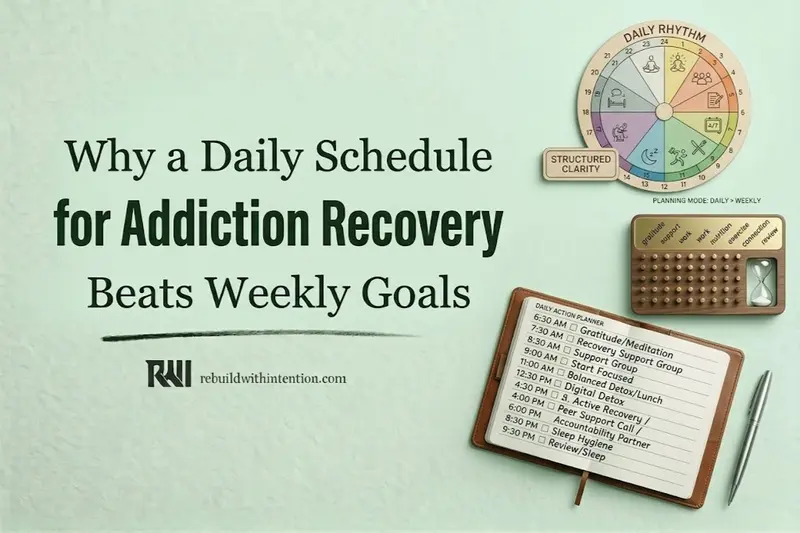
A daily plan helps create order and stability, which is very important when working on recovery. It is an essential part of proven treatments like Cognitive Behavioral Therapy (CBT) because it helps change the habits that keep addiction going.
Here’s why having a daily routine is one of the most effective early recovery tips
1. It Shrinks the Overwhelm and Creates Intense Focus
When I set weekly goals, I was disorganized. The vague idea of “being clean for 7 days” was overwhelming.
The feeling of dopamine deprivation would rush in, and even if I didn’t relapse right away, I’d find myself lurking around explicit content or watching romance movies, trying to find a substitute for the feeling I was missing.
I was trying to quit for quitting’s sake, without a real system in place.
By focusing on just one day at a time, the fight becomes manageable. For a recovery brain, setting a goal to stay clean for one day is doable. It’s not an impossible mountain; it’s a single hill.
You can fill your day with activities, and before you know it, the day is over. Mission accomplished.
This focus alleviates the “decision fatigue”—the mental exhaustion from making countless small choices—that plagues early recovery.
2. It Closes the Loop and Delivers a Daily Win
This is perhaps the most critical concept. A weekly or monthly goal is an “open loop.” You don’t feel fulfilled or get that sense of achievement until the entire period is over.
If you relapse on day three of a seven-day goal, the loop is broken. You condemn yourself, feel like a failure, and often keep relapsing until you decide to “start again” next week.
A daily plan is a “closed loop.” Think of it like a farmer. The farmer wakes up, does the important things—brushes his teeth, eats, works the farm, comes home, eats again, sleeps.
At the end of the day, he doesn’t feel like he wasted it. He knows he did the work. He closes the loop. The next day, he opens a new one and repeats the process.
You get to feel the victory of success every single night. That feeling of accomplishment becomes its own reward, replacing the cheap dopamine from your addiction with earned, meaningful satisfaction.
3. It Differentiates “End Goals” and “Means Goals.”
Why do you want to stay clean for a week? What is the feeling you are hoping to feel at the end of that week? Is it pride? Self-respect? Peace? Accomplishment?
That feeling is your End Goal. The seven-day streak is just the Means Goal—the vehicle you think you need to get the feeling.
When I started rebuilding my life, I realized one of my true end goals was simple: to wake up every morning without regret. With a daily plan, I didn’t have to wait until the end of the week or month to achieve this.
By successfully completing my plan each day, I woke up the very next morning with that exact feeling. I was achieving my end goal instantly, every 24 hours.
4. It Leverages the Unstoppable Power of Compounding
Working on yourself daily is what compounds into a week, a month, and eventually, a year of progress. A farmer doesn’t harvest his crop after one week of farming.
He knows the harvest will come when the time is right. He learns to find joy not in the distant harvest, but in the daily process of tending the soil.
Let say you place a drum under a faucet that drips water. A single drop of water doesn’t matter much. But if the water keeps dripping, the drum will fill up in just a few days. Your daily actions are like those drops.
Every day you finish something, or keep a small promise to yourself, is another drop in the drum. Soon, you will notice that the progress has built up and become strong.
5. Daily Schedule is Designed for a Brain Impaired by Addiction
Let’s be honest. Addiction, especially to things like porn, damages our brains. One of the most common effects is brain fog and a shortened attention span.
When I was deep in my addiction, I developed a terrible memory. I wasn’t losing my mind, but I simply couldn’t retain information unless I wrote it down and set constant reminders.
A weekly goal is too abstract for a brain struggling with focus. A daily plan, however, is concrete and immediate. It works with your brain, not against it, providing the external structure your mind is currently lacking.
6. It Rebuilds Self-Discipline and Trust
Being addicted to something can make it hard to trust yourself. But making a daily plan can help you build that trust back slowly.
Doing small tasks such as making your bed, going for a walk, or writing in a journal for ten minutes might feel small, but each task you finish shows that you are keeping promises to yourself.
These little successes build up over time. They help you feel more capable and confident, which is important for improving their belief that “I am capable of change, and I can trust myself once more.”
7. It Creates a Foundation for Healthy Habits
To truly recover and get better, you need to create a new way of living. Having a daily plan is like having a guide to help you stay on track. It makes it easier to include important habits in your life that will help you heal and grow.
- Consistent Sleep: A regular sleep schedule is essential for regulating mood and improving impulse control. Poor sleep is a massive predictor of relapse.
- Nutritious Meals: Your brain needs fuel to heal. Planning your meals—even just deciding what you’ll eat tomorrow—is a profound act of self-care.
- Regular Exercise: Physical activity is a powerful tool for managing stress. Even 20 pushups or a 30-minute walk can directly combat anxiety.
The Step-by-Step Guide to Building Your Daily Survival Plan
This is the exact system I used to build my new life.
Step 1: Find Your Real “Why” (The 5 Whys Technique)
Your plan needs fuel. That fuel is your “why,” but your surface-level why isn’t strong enough. You must dig deeper.
- Start with your surface goal: “I want to quit my addiction.”
- Ask Why #1: “Why do you want to quit?” (Maybe: “So I can love my spouse again and not objectify people.”)
- Ask Why #2: “Why do you want to be able to love your spouse again?” (Maybe: “Because my addiction has made me distant and I’m afraid of losing them.”)
- Ask Why #3: “Why are you afraid of losing them?” (Maybe: “Because they are the most important person in my life and I feel immense shame for hurting them.”)
- Ask Why #4: “Why do you feel that shame?” (Maybe: “Because I know I’m a better man than this, and I’m living a life that is out of alignment with my values.”)
- Ask Why #5: “Why is living out of alignment so painful?” (Maybe: “Because it feels like I’m wasting my one life. I feel hollow and full of regret every single day.”)
That final answer—that raw, painful feeling—is your real why. It is the outcome you can no longer tolerate.
Write it down. Send it to yourself as a scheduled text every morning. Put it on a sticky note on your mirror. This is your driving force.
Step 2: Create Your “Non-Negotiable” Routine (The 3-5 Rule)
You are not creating an absurd, 10-item routine you’ve never done before. You will burn out. Start with just 3-5 non-negotiable activities that directly support your “why.” These three are mandatory:
1. Learning:
To improve, you must learn. Take a course, read a book, or watch a video on the area you want to improve (e.g., healthy relationships, financial literacy). Spend 15-30 minutes on this. Just finish one lesson or one chapter to close the loop.
2. Exercising:
This is not optional. It changes your brain chemistry. Do 20 pushups (increase your rep overtime). Go for a 30-minute walk. Your routine doesn’t need to be long, but it must happen.
3. Journaling:
By writing, you will start identifying things about yourself that you knew but weren’t paying attention to. The more you write, the more you will understand your own triggers and patterns.
Add 1-2 more activities of your choice. Maybe it’s meditation, practicing a hobby, or calling a family member. Your entire non-negotiable routine shouldn’t take more than an hour or two to complete.
Step 3: Engineer Your Cues (Attack Mode)
Every habit follows a loop: Cue -> Routine -> Reward. You need to be ruthless about engineering your cues.
Remove Negative Cues:
This is non-negotiable. Social media apps are open loops designed to addict you. Delete them from your phone. The same goes for seasonal movies and video games. Your goal is to avoid automation and embrace manual, intentional action.
Add Positive Cues:
Your new best friends are your hands and a book. Make your journal and a pen visible on your desk. Put your running shoes where you will see them when you wake up. If you want to cook more, go to the market and buy the food—those are your cues.
I have a full-time job from 6 AM to 4 PM. I tailored my routine around it by waking up at 4 AM to start “my own day” before my job’s day started. Find the pockets in your day and defend them fiercely.
Step 4: Execute, Repeat, and Embrace Imperfection
Your only job tomorrow is to execute the plan. Don’t think about the next day. Just follow the plan.
And know this: you will have a day where you don’t stick to it. This is not a failure; it is a guarantee. The goal isn’t flawless execution—it’s to get back on track without spiraling.
- Don’t Catastrophize: Missing one activity doesn’t ruin the day. Acknowledge it and refocus on the very next item on your schedule.
- Analyze, Don’t Criticize: Ask “why” did I miss that? Was the schedule unrealistic? Did a trigger pop up? Use it as data to make tomorrow’s plan better.
- Reach Out Immediately: This is a perfect time to call a sponsor or support person. Saying “I’m having a tough time” is a recovery win in itself.
Living Intentionally, One Day at a Time
It is good to have a grand yearly goal. But for once, I challenge you to focus on just a single day. Find the hidden “why” behind your long-term goals. How do you want to feel? What habits would the future you have?
Break that down into a small set of practices you can complete in a single day. A drop can create an ocean. Live intentionally, one day at a time.
The dopamine you get from finishing your daily schedule for addiction recovery is a thousand times more powerful than the empty high of your addiction.
It is the feeling of fulfillment, of knowing you are finally the driver of your own life. And you can feel it tomorrow
Discover more from Rebuild With Intention
Subscribe to get the latest posts sent to your email.