
I’ve tried every productivity routine on the internet. The 5 AM club. The miracle morning. The evening ritual: journaling, meditation, gratitude lists, and cold showers.
All of them designed by people who seemingly have unlimited energy, no depression, and a personal chef.
They all failed.
Not because they’re bad routines — they’re probably great for someone.
But for someone in my situation — low energy, low motivation, broke, dealing with the aftermath of a life that fell apart — those routines might as well be written in a different language.
I cobbled together the absolute minimum set of actions that, when I actually do them, make my day noticeably less terrible. That’s the goal. Not “optimized.” Not “productive.” Just manageable enough to do daily.
The Morning (15 Minutes Max)
I don’t set an alarm for 5 AM. I set one for a consistent time that I can actually maintain. For me, that’s 8:30. The goal isn’t to be impressive. The goal is to be consistent.
When I wake up, I do three things before I touch my phone:
1. Hydrate
Drink a glass of water before touching your phone. Baseline maintenance matters.
2. Make the Bed
Just pull the covers up. Ensure there’s at least one thing in the room that’s in order.
3. Step Outside
Stand on the porch for 2 minutes. The sunlight and air will reset your brain.
That’s it. That’s the morning routine. Water, bed, outside. Fifteen minutes on a slow day, five on a fast one. Keeping it simple can help you feel capable of starting, even on tough days.
Recommended Article: How I Beat Morning Numbness and Reclaimed Control of My Mind
The Daily Anchor (1 Hour)
After the morning basics, I have one rule: do one meaningful thing before noon. Not five things. Not a full work day. One thing.
Some days that’s applying for a job. Some days it’s watching a free course video and taking notes. Some days it’s writing for this blog. Some days it’s making a phone call I’ve been avoiding.
The point is that by noon, I’ve moved something forward, even if it’s small.
Lower the Target. Hit It.
A day with one completed task feels infinitely better than a day with five planned tasks and zero completed. This protects against all-or-nothing thinking. Now, the list is one item long. It’s a lot harder to fail.
If I do more than one thing, great. But the minimum is one. This protects me from the all-or-nothing thinking that used to ruin me. Before, if I didn’t do everything on the list, I’d do nothing.
Now, the list is one item long. It’s a lot harder to fail.
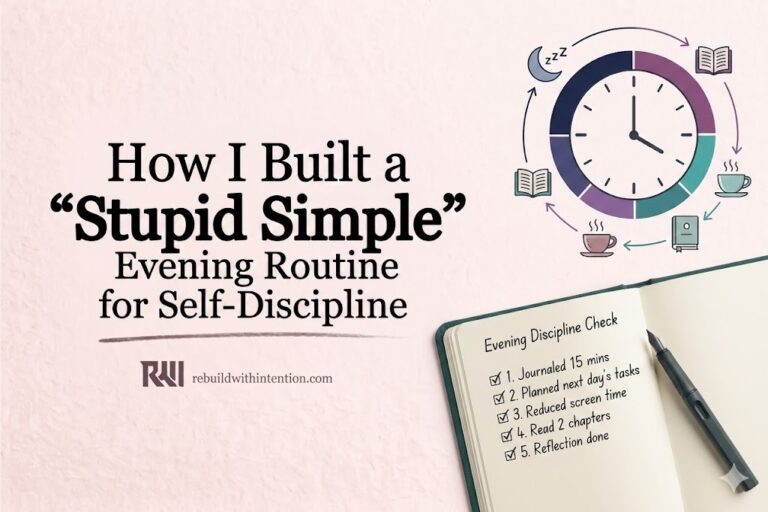
The Evening (10 Minutes)
Evenings are where I’ve historically lost every battle. The unstructured hours between dinner and sleep are when the old habits come alive.
So I’ve built a small fence around them. Not a wall — walls make me claustrophobic and I tear them down. A fence.
Why This Works (When It Works)
This routine works for me because it respects where I actually am, not where I want to be. It doesn’t require money, equipment, a gym membership, or energy I don’t have.
It can be done on a bad mental health day. It can be done when I’m exhausted. It can be done when I don’t feel like doing anything at all.
The other routines I tried failed because they assumed a baseline of functionality that I don’t currently have. They were designed for optimization. I need something designed for survival.
What Changed When I Started Doing This
Honestly? Nothing dramatic at first. But after about ten days of sticking with it, I started to notice small changes:
- I was falling asleep earlier and sleeping better.
- The existential dread that usually hits around 2 PM was slightly softer.
- I had a small but real sense of momentum — like I was at least pointed in a direction, even if I wasn’t moving fast.
- I stopped having days where I literally did nothing. Every day had at least one thing I could point to.
That’s not a transformation. It’s a foundation. And right now, a foundation is the most important thing I can build.
If you’re in a similar place, don’t try to adopt someone else’s optimized routine. Build your own minimum.
Make it so simple you almost can’t fail. Then do it for ten days and see what shifts.
It won’t fix everything. But it might give you something to stand on.
Recommended Resources
Discover more from Rebuild With Intention
Subscribe to get the latest posts sent to your email.