There are days when motivation feels real. You wake up with a lot of energy and make a plan. You tell yourself this is the week everything changes.
You clean your space, write a list, and maybe watch something that makes you feel like the old version of you is finally gone.
Then the feeling leaves. Like it fades.
Just because you miss one task, sleep badly, or get a little bit distracted.
The money stress comes back, and your room starts looking like your head. The routine you were so sure about suddenly feels heavy.
The same motivational content that made you feel powerful on Monday feels annoying by Thursday.
This is where we need to get honest with ourselves.
We are not failing because we did not want a better life badly enough. We are failing because we keep trying to rebuild our lives on top of a feeling.
And feelings change.
We can not make motivation the center of the rebuild.
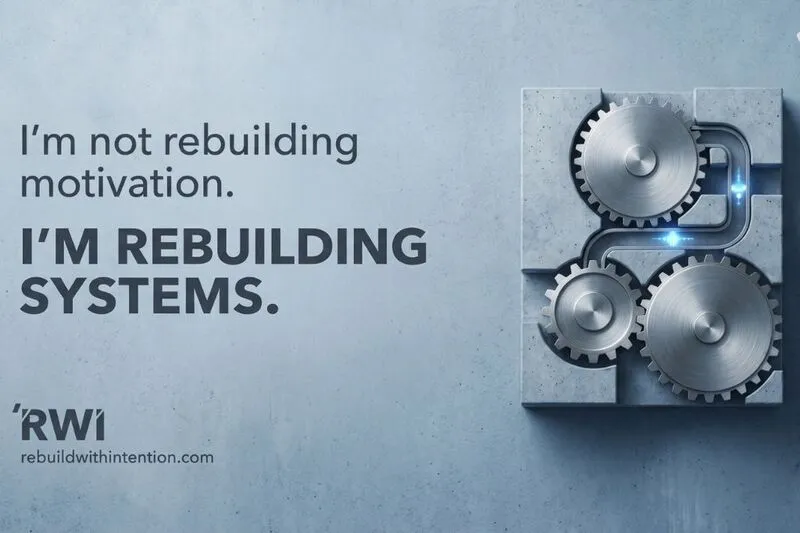
I stopped rebuilding with motivation and start rebuilding with systems.
Motivation was never reliable enough to carry the whole rebuild.
Motivation is not useless. Don’t get me wrong.
Sometimes motivation can help you start, give meaning to something you have been carrying quietly.
A motivational video, an article, a conversation, or a hard moment can sometimes be what wakes you up enough to say, “I cannot keep living like this.”
Yes, that matters.
But motivation is a poor foundation because it relies heavily on your emotional state.
Motivation assumes you will always feel clear and strong, remember why you started, and have the energy to do the work when it needs to be done.
But that is not how it works.
Life includes tired mornings, unpaid bills, awkward conversations, cravings, distractions, bad habits, low moods, and days where the best you can do is not make things worse.
A system, however, is different.
A system does not need you to feel inspired. Instead, it gives you something to follow when inspiration is gone.
A system won’t give you emotional intensity; it won’t promise to make you into a completely different person by next month. or another version of yourself performing discipline online while quietly falling apart offline.
What we need is a structure.
Something boring enough to repeat and honest enough to survive bad days.
The Reality of Progress: Emotion vs. Structure
The real problem was not laziness. It was lack of structure.
It is easy to call yourself lazy when your life is disorganized. I have been there.
You look at the missed tasks, the ignored messages, the money you did not track, the routine you abandoned, and the promises you made to yourself again.
The simple explanation is, “I am lazy.”
But sometimes laziness is not the most accurate word. Sometimes the issue is that there is no system holding the basics together.
There is no clear morning structure, weekly review, no money visibility, no simple checklist for low-capacity days, no reset process after falling off.
You don’t have an environment that makes the right action easier, nor an honest tracking of what is actually happening.
When there is no structure, every task becomes a fresh emotional negotiation.
You keep asking yourself:
Should I wake up now? Should I clean this today? Should I check my account balance? Should I work on the thing I said mattered? Should I cook, order food, skip it, or pretend I am not hungry? Should I reply now or avoid it until it becomes heavier?
That kind of life burns energy before the real work even starts.
A system reduces the number of decisions you have to make from scratch. It turns the basics into a practiced pattern.
We do not need a system because we are naturally disciplined. We need a system because we are not naturally consistent without one.
Systems make discipline less emotional
Discipline is often perceived as a personality trait. Some people “have it.” Some people do not. Some people are built differently. Some people just need to want it more.
I do not believe that anymore. Discipline is not a personality trait. It is a system I have to practice.
When we make discipline too emotional, we turn every failure into an identity crisis.
Discipline says: If I miss a day, I am undisciplined. If I avoid a task, I am broken. If I fall back into an old pattern, I must not have changed at all.
That mindset does not help us rebuild. It just adds shame to the work.
Shame Gives You A Label
- ✕ “I am lazy.”
- ✕ “I can’t stick to anything.”
A System Gives You A Next Step
- ✓ Did I follow the checklist today?
- ✓ What is the smallest reset?
I created Rebuild With Intention to document the process of rebuilding from zero with honesty, structure, and practical self-respect. Not because or to show that I am already successful.
The work is not always impressive. Most of it is repetition. But repetition is where control slowly comes back.
The Minimum Viable Day: a system for low-capacity days
One of the biggest mistakes I made was designing routines for the version of myself who had maximum energy. That version of me could do everything.
The problem is that I kept building plans for my best state and then judging myself from my worst state. That created a cycle:
High-energy planning → Low-energy failure → Shame → Avoidance → Restart → Repeat.
I needed a system that could survive ordinary human inconsistency. That is where the Minimum Viable Day helps.
A Minimum Viable Day is the smallest version of a successful day that keeps you connected to the rebuild.
A daily routine will always beat a weekly, monthly, or yearly goal.
The question is simple: If today is messy, what are the few actions that stop me from drifting further?
My MVD Checklist
Small is repeatable. And when you are rebuilding from instability, repeatable matters more than impressive.
Build systems around your real patterns
A system does not work on excuses but only on Reality.
An excuse says, “I cannot change because this is hard.” Reality says, “This is hard, so the system needs to account for where it usually breaks.”
A simple weekly rebuild review
Daily discipline matters, but weekly review is where patterns become visible. Without review, I can lie to myself in both directions.
Control comes back through repetition, not intensity
Intensity felt serious. It felt like proof. But intensity without structure usually became another cycle I could not maintain.
Repetition is quieter. You check the list. You clean the same space again. You return again. It can feel ordinary. But when life has been unstable, ordinary can be a form of repair.
Internally, they rebuild trust. Becoming someone who has a way back when struggle happens.
Final thought: build proof, not performance
I’m not selling a success story like everyone else. Instead, I am just documenting the process.
Which also means I need systems that can survive in the real world. Not another groundless promise that this time we will become unrecognizable.
Tell the truth. Build the system. Follow the checklist. Adjust what breaks. Return faster. Repeat.
I recommend starting with our freemium Rebuild OS.
Rebuilding does not always feel powerful while it is happening. Most of the time, it feels ordinary. Like quietly building proof, which is the work aspect of it, before a comeback.
Discover more from Rebuild With Intention
Subscribe to get the latest posts sent to your email.