When I began my journey to rebuild my life, one of my top priorities was to educate myself. I didn’t mean it in a general sense of self-improvement; I needed real, practical knowledge that could help me land a job.
However, I quickly realized that learning often comes with a price tag: classes and certifications can be expensive, and even books can add up.
Unfortunately, I found myself in a tough spot with little to no money to invest in my education. So I went looking for what was actually free. Not “free” with a trial. Not “free” until checkout. Free free.
And there is a ridiculous amount of high-quality education online if you know where to look and you have enough discipline not to turn the search into another form of procrastination.
If you’ve read my post about building a simple daily routine, this is the learning block inside that routine. This is the stack I actually use.
Can you really educate yourself with no money?
Yes.
If you have internet access, a library card, and thirty focused minutes a day, you can build a serious free education stack. It may not give you every certificate. It may not look glamorous. But the knowledge is there.
The bigger problem is usually not access. It is consistency.
1. The library. Seriously.
I know. The library sounds like advice from 1995.
But the public library is still one of the highest-value things available to a broke person.
Books, obviously. But also quiet space, internet access, and digital borrowing. If you have a library card, you can usually take out books to read, as well as access ebooks and audiobooks through Libby, and some library systems also give access to platforms like LinkedIn Learning.
Libby is an application that allows you to borrow ebooks, audiobooks, and magazines from your library for free if you have a library card.
If your home is noisy or distracting, having access to a library is very important. A quiet space is not just nice to have; it is essential when you are trying to focus and rebuild. That kind of space provides the support you need.
2. YouTube, but with discipline
YouTube is both the best and worst school on the internet.
YouTube is powerful because you can learn almost anything there. But it can also be bad because one suggested video can make you spend hours watching without realizing it.
I use YouTube like a school. I look for the specific thing I want to learn. I watch the video, take notes, and then I close the page. I don’t just scroll or let videos play one after another.
It’s free, but it takes self-control to use it wisely.
3. Legal Front Door to Learning
This is the best thing I took from that OneHack post.
There is a whole legal front door to free education that most people skip.
When I need something, this is where I start.
If I need free textbooks, I check OpenStax and the Open Textbook Library. OpenStax offers free textbooks, and the Open Textbook Library provides books you can download and use at no cost.
If I want real course materials, I use MIT OpenCourseWare and OpenLearn. MIT OpenCourseWare publishes free materials from more than 2,500 MIT courses, and OpenLearn offers hundreds of free short courses from The Open University.
OpenLearn is good when I want shorter courses. MIT OpenCourseWare is good when I want full course materials and don’t mind a more academic format. OpenStax is good when what I really need is a textbook, not another personality-driven video course.
If I need papers instead of books, I start with BASE, CORE, OpenAlex, and Unpaywall.
BASE covers more than 400 million documents from more than 12,000 providers, CORE positions itself as the world’s largest collection of open-access research papers, OpenAlex is a free and open catalog of the research system, and Unpaywall is built to help people legally find free versions of papers.
That one shift alone makes the whole learning process cleaner. Instead of randomly hunting for material, you have a front door.
4. Free Online Courses
For structured learning, I keep coming back to the same places.
Khan Academy is still one of the cleanest places online to fill foundation gaps. Their goal is to make high-quality education available to anyone, anywhere.
freeCodeCamp is one of the best things on the internet if you want practical tech skills. It has a full free curriculum, plus tutorials and free certifications.
5. Free Books
When looking for books, I usually begin at the library. I also like to check the Internet Archive. This website is great for finding books that are free to borrow, especially older titles or books that are in the public domain.
They let me preview a book before deciding whether to buy it. Open Library has over 3 million books that you can read and borrow for free, while the Internet Archive also offers many free books to read or borrow.
I’m not anti-author. I’m currently in a stage of life where “buy every book you want” is a fantasy. When I can afford to support authors more directly, I will. Until then, I’m using what is legally available and actually accessible.
The tools I use are boring, which is exactly why they work
The tools part is simple.
- Google Docs and Tasks for notes, plans, and messy thinking.
- Notion for storing what I learn.
- NotebookLM when I want something to actually stay in my head.
- VS Code if I’m learning anything technical.
These tools won’t make you smarter on their own. However, they make things easier, and that is important.
The real problem is not a lack of resources
There are a lot of resources available to help you learn. The big issue is that learning can feel difficult when life is already tough.
When you are stressed, struggling with money, and unsure about what will happen next, your mind often craves a break rather than more hard work. That is why I don’t try to do four-hour study marathons. I aim for one hour day.
- An hour or thirty minutes is small enough to start.
- Small enough to do even when I don’t feel like it.
- And over time, it stops being small.
I study six days a week. I take real notes, learn real skills, and make real progress. This is not just about feeling motivated; it’s about actually getting better. This is not just about feeling motivated; it’s about making real progress.
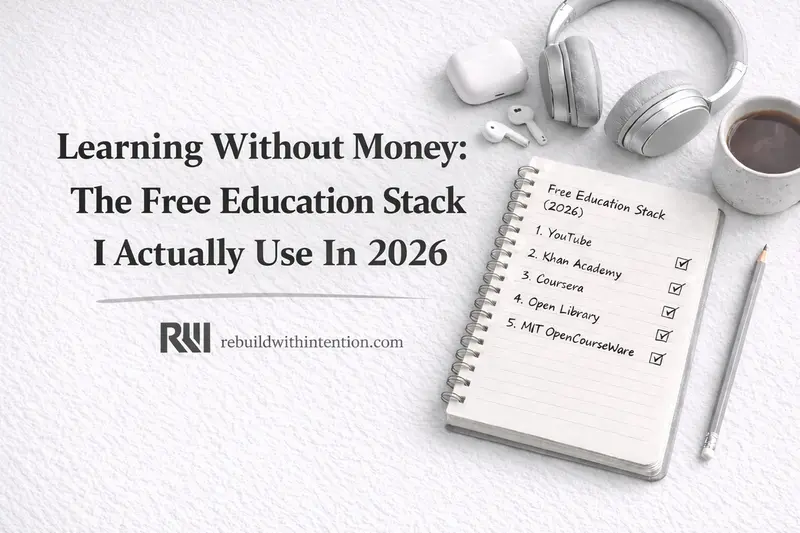
Here’s what I use to learn right now:
→ YouTube for lessons on different topics
→ Khan Academy to help with any subjects I don’t understand
→ freeCodeCamp for hands-on practice with tech skills
→ OpenStax or Open Textbook Library for free textbooks
→ MIT OpenCourseWare or OpenLearn for organized courses
→ BASE, CORE, OpenAlex, and Unpaywall for research papers
I keep everything organized using Docs, Notion, NotebookLM, and VS Code.
This is my way of learning. It’s simple, affordable, and focused—just helpful tools.
Final thought
You don’t need a lot of money to start learning new things. You need a simple, clear way to approach your learning. Here’s my easy method:
▸ Look for free ways to learn.
▸ Use trusted and legal websites instead of risky ones.
▸ Study for thirty minutes every day.
▸ Take notes on what you learn.
▸ Review your notes and study again the next day.
It might not sound exciting, but it is helping me a lot.
Quick answers
Can you learn useful skills online for free?
Yes. You can build real skills for free with a library card, open textbooks, open courseware, targeted YouTube lessons, and free platforms like Khan Academy and freeCodeCamp.
Where can you find free textbooks legally?
Good legal starting points are OpenStax, the Open Textbook Library, the library, Open Library, and the Internet Archive.