I Reverse Engineered How Ad Blockers Are Skewing Conversion Data By Over 36%
How I reconciled 50,000 backend server logs against front-end analytics events to expose massive attribution decay—and the server-side architecture required to fix it.
If you are an e-commerce director, you probably check your Shopify or Google Analytics dashboard every morning, calculate your Return on Ad Spend (ROAS), and allocate your budget.
But due to aggressive ad blockers and browser-level privacy protocols (like Safari’s ITP and Brave’s Shields), client-side tracking is hemorrhaging data.
To simulate a modern e-commerce attribution environment, I generated and reconciled 50,000 transaction records from backend server logs and browser-side analytics events to measure how much conversion data is lost before reaching analytics dashboards.
The results?
Up to 36% of transactions were completed perfectly on the backend server but disappeared completely before reaching the front-end marketing dashboards.
These are Ghost Transactions.
So I built a comparative architecture to hunt them down, tracking exactly how much revenue was slipping through the cracks.
Methodology
To find the discrepancy, I pitted the backend database against the front-end tracking pixel data.
By mapping the server’s transaction_id to the client’s order_id via a LEFT JOIN, I identified the payloads that were blocked by ad blockers.
Finding the missing data was only the first step. I needed to prove exactly what was blocking it.
User-Agent Spoofing
When diagnosing attribution loss, trying to segment the missing data by querying the user_agent string is a rookie mistake.
Privacy-first browsers like Brave intentionally spoof their User-Agent strings to look identical to standard Google Chrome traffic. Relying on basic SQL filtering will simply show massive, unexplained drops in “Chrome” conversions, completely masking the real culprit.
To accurately identify the ghost transactions, I had to dig deeper into the server logs and parse the sec-ch-ua (Client Hints) HTTP headers.
This is one of the only reliable, deterministic ways to strip away the Chrome disguise on the backend and expose the actual browser environment.
Here is the exact reconciliation logic I used to map the database truth against the decaying analytics payloads:
View Full SQL Query
WITH DiscrepancyBase AS (
    SELECT s.transaction_id, s.revenue, s.sec_ch_ua_header, s.user_agent,
        CASE
	WHEN c.order_id IS NULL THEN 1 ELSE 0 END AS is_ghost_transaction
    FROM server_logs s
    LEFT JOIN client_events c ON s.transaction_id = c.order_id
),
BrowserAnalysis AS (
    SELECT
        CASE
            WHEN sec_ch_ua_header LIKE '%Brave%' THEN 'Brave (Shields Up)'
            WHEN user_agent LIKE '%Safari%' AND user_agent NOT LIKE '%Chrome%' THEN 'Safari (ITP Impact)'
            WHEN user_agent LIKE '%Firefox%' THEN 'Firefox (ETP)'
            WHEN user_agent LIKE '%Chrome%' THEN 'Standard Chrome (uBlock/Adblock)'
            ELSE 'Other/Unknown'
        END AS browser_segment,
        COUNT(*) AS total_server_transactions,
        SUM(is_ghost_transaction) AS blocked_client_events,
        ROUND((SUM(is_ghost_transaction) * 100.0) / COUNT(*), 2) AS data_loss_percentage,
        ROUND(SUM(CASE WHEN is_ghost_transaction = 1 THEN revenue ELSE 0 END),2) AS untracked_revenue
    FROM DiscrepancyBase
    GROUP BY browser_segment
)
SELECT * FROM BrowserAnalysis
UNION ALL
SELECT
    'TOTAL',
	SUM(total_server_transactions),
	SUM(blocked_client_events),
	ROUND((SUM(blocked_client_events) * 100.0) /SUM(total_server_transactions),2),
	ROUND(SUM(untracked_revenue), 2)
FROM BrowserAnalysis
ORDER BY untracked_revenue DESC;
Business Impact
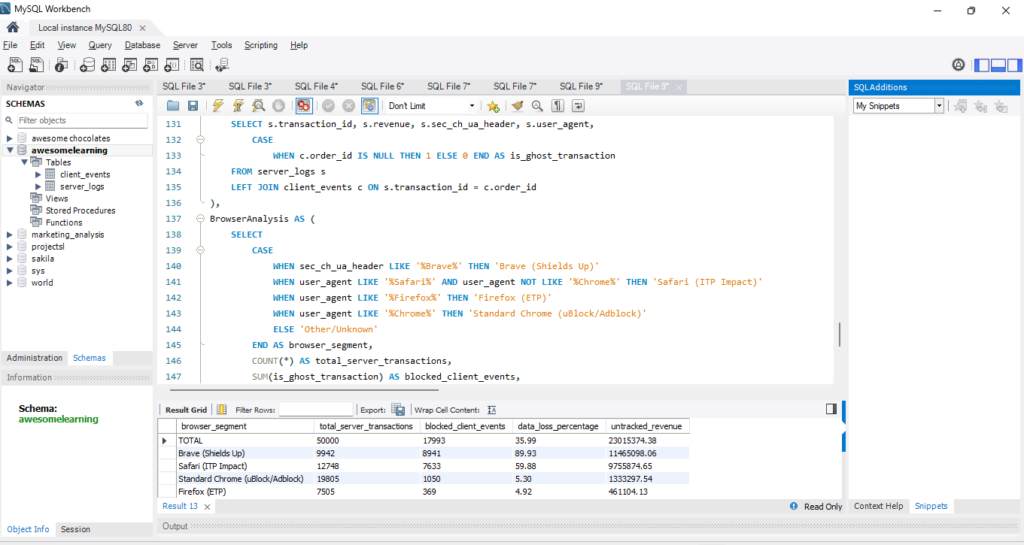
When the reconciliation query completed, the discrepancy was impossible to ignore. Across the dataset, 35.99% of completed purchases were recorded on the backend but never reached the analytics layer.
The 35.99% Attribution Gap
Comparative analysis between backend server-side transaction logs and client-side analytics events across 50,000 ecommerce purchases.
For e-commerce operators, this creates a dangerous measurement illusion.
A campaign that generates a highly profitable 4.2x ROAS might appear as a mediocre 2.7x in Meta Ads Manager.
This discrepancy can trigger a cascade of compounding system failures:
A growing percentage of attribution loss is not due to weaker campaign performance. It is a direct result of browser-enforced privacy restrictions executing after a successful checkout.
What Most Analytics Teams Miss
Most analysts attempt to identify browser-level attribution loss solely using the user_agent field.
The problem is that privacy-focused browsers like Brave intentionally spoof their User-Agent strings to appear identical to standard Chrome traffic.
Without parsing deeper HTTP Client Hint headers such as sec-ch-ua, attribution loss becomes incorrectly categorized as generic Chrome suppression.
This creates misleading browser segmentation, hides the true scale of privacy-related data loss, and causes teams to underestimate the extent to which modern browsers interfere with client-side measurement infrastructure.
So What?
The era of relying exclusively on browser-side pixels is ending. Modern attribution systems must evolve toward server-side measurement architectures that can withstand browser privacy enforcement without violating user consent frameworks.
To stop attribution decay, e-commerce data stacks require a shift to first-party event collection pipelines and direct server-to-server payload delivery:
By moving tag execution off the browser via Server-Side Google Tag Manager (sGTM) and pushing data through the Conversion APIs (Meta CAPI), you stop relying on the user’s browser as the source of truth.
The goal for growth teams is no longer perfect attribution. The goal is attribution resilience.
When your dashboards drift too far from your backend financial reality, you stop optimizing campaigns and start optimizing measurement errors.
If your analytics platform reports one number and your database reports another, you have ghosts in your data.
It is time to build a system that hunts them down.
Stop optimizing for measurement errors.
If your tracking is bleeding data, your SQL pipelines are a mess, or your dashboards don’t match your bank account, let’s fix it. I build clean, resilient measurement architecture so you can actually trust your numbers.